
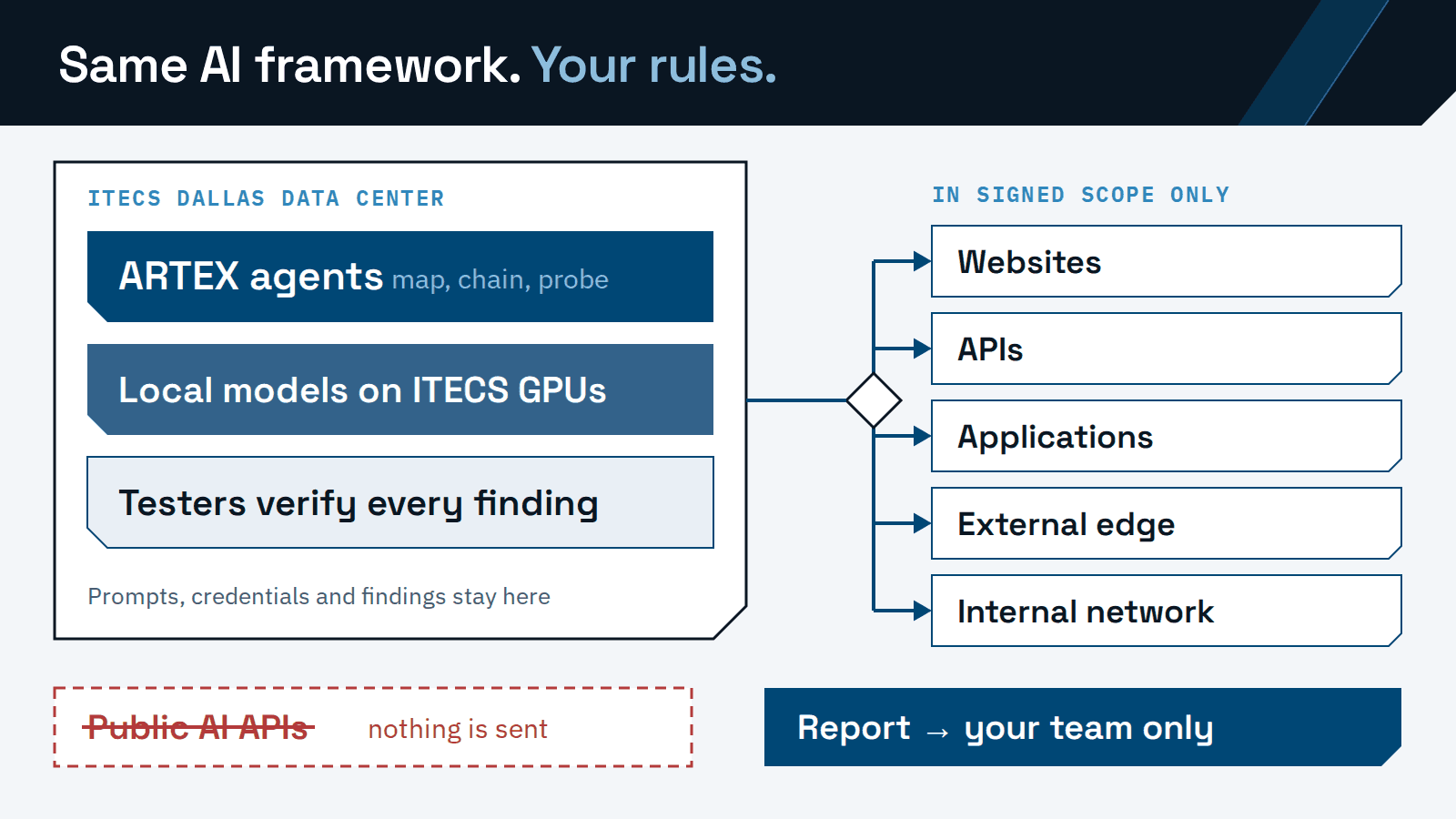
On November 13, 2026, the FBI warned that criminal groups are using ARTEX, an open-source AI penetration-testing framework, to break into companies. In some intrusions, attackers went from first contact to privileged access in under three hours. ITECS runs its own hardened copy of the same framework against your websites, APIs, applications and network edge, with your written permission, on AI models it hosts in its own Dallas data center. You find out where you are exposed before an attacker does, and none of the test data leaves ITECS hardware.
What the FBI said about ARTEX
The alert is FBI FLASH-20261113-001, released through the Internet Crime Complaint Center and marked TLP:CLEAR, so it can be shared freely. It describes ARTEX as an autonomous, multi-agent penetration-testing platform. An operator states a goal in plain language. ARTEX agents turn it into commands, run them and decide what to try next, with little human input after the goal is set.
ARTEX has no AI model of its own. It connects to whichever model the operator chooses, from Anthropic Claude and OpenAI GPT to DeepSeek, GLM, Grok and Kimi. In attacker-controlled instances, the FBI says, DeepSeek Flash-family models dominate because they are cheap and showed no observable guardrails when a request was framed as penetration testing.
A developer released ARTEX on GitHub in July 2026. According to the FBI, the developer said it was intended for authorized security testing within defined scopes. Criminal use began by August 2026 at the latest, and the developer pulled the repository on October 8 after reports of abuse. Community forks, archived copies, localized variants and a commercial edition called ARTEX PRO keep it in circulation.
Reported by the FBI
Under 3 hours
From initial targeting to privileged access, in some ARTEX intrusions
10 sectors
Named in the alert, from financial services and healthcare to manufacturing and legal
1,600+
Publicly exposed ARTEX consoles found by researchers in early November 2026
≈67,000
People whose personal information was exfiltrated from South Korean financial institutions
Two campaigns in the alert show what is at stake. Attacks on South Korean financial institutions exfiltrated personal information on about 67,000 people. A supply-chain compromise affecting ConnectWise Cloud Backup customers led to attempted sign-ins to more than 2,250 downstream tenants. The FBI also says ARTEX lets small groups with little expertise run several intrusion campaigns at once.
Why a board should treat this as a timing problem
Many companies test their defenses once a year. Attackers now work on a much shorter clock. CrowdStrike's 2026 Global Threat Report puts average eCrime breakout time, the gap between first access and moving to other systems, at 29 minutes; the fastest it observed was 27 seconds. Google's Mandiant estimates the mean time to exploit a vulnerability at minus seven days, which means attackers often use a flaw before a patch exists.
Exploitation is also now the main way in. Verizon's 2026 Data Breach Investigations Report found that exploited vulnerabilities started 31 percent of breaches, up from 20 percent a year earlier, overtaking stolen credentials. IBM's 2026 Cost of a Data Breach report puts the global average breach at a record $4.99 million, and it found that one in four malicious breaches was AI-enabled, at about $6 million each.
Published research, 2026 editions
How fast attackers move
27 sec
Fastest eCrime breakout time observed in 2025
CrowdStrike 2026
29 min
Average eCrime breakout time, 65% faster than in 2024
CrowdStrike 2026
< 3 hours
To privileged access in some ARTEX intrusions
FBI, Nov. 2026
−7 days
Estimated mean time to exploit: attackers often strike before a patch exists
Mandiant M-Trends 2026
What it costs
31%
Of breaches start with an exploited vulnerability, up from 20% a year earlier
Verizon DBIR 2026
$4.99M
Global average cost of a data breach, a record high
IBM 2026
≈$6M
Average cost of an AI-enabled breach; one in four malicious breaches was AI-enabled
IBM 2026
Frameworks like ARTEX shorten that clock again, because agents take over the enumeration and testing steps that used to take a skilled person days. The FBI says ARTEX is especially good at finding peripheral systems that get less attention than a company's flagship applications: partner and supplier portals, mobile app backends, legacy services, third-party integrations and apps built by individual business units. Those are the systems an annual test is most likely to miss.
What the attacks had in common
The intrusions described so far did not need exotic flaws. Amazon's security team, which saw ARTEX agent traffic hit its decoy sensors from October 3 to November 5, said the agents succeeded where basic security hygiene was missing, including default or hardcoded credentials. Barracuda traced an intrusion to a valid cloud access key it had given a third-party AI vendor and never retired after that work ended; the attacker touched about 10 cloud accounts in roughly 44 hours. Barracuda says the activity matches how ARTEX operates, but that the match does not identify the attacker.
For leadership, the lesson is practical. AI makes ordinary mistakes faster to find: the forgotten key, the default password, the portal nobody owns. The defense is to find those mistakes first, at the same speed, and fix them.
Same framework, different rules
Criminal operators and ITECS start from the same framework. What changes is which build runs, who authorized the test, which model drives it, where the data goes and who checks the results. The table compares the criminal use the FBI describes with how ITECS runs an engagement.
Comparison
| Aspect | Criminal use (FBI alert) | ITECS engagement |
|---|---|---|
| The software | Whatever copy circulates. The FBI says ARTEX spreads through community forks, archived copies, localized variants and a commercial edition, ARTEX PRO. | ITECS's own copy of the original release, reviewed for backdoors, blocked from unauthorized endpoints, and hardwired to non-destructive testing methods. |
| The model | Usually a low-cost hosted model. The FBI says DeepSeek Flash-family models dominate for their cost and lack of observable guardrails. | GLM-5.3 and APEX, run on ITECS GPU servers in its Dallas data center. |
| Where the data goes | To the external AI provider the operator connects. | Prompts, credentials, target data and draft findings stay on ITECS-owned hardware. Nothing goes to a public AI API. |
| What gets tested | Organizations that never agreed to it. The FBI says ARTEX excels at peripheral systems that get less security attention. | Only the targets and testing windows named in your signed rules of engagement. Excluded systems stay off-limits. |
| The goal | Privileged access and data theft, in under three hours in some intrusions. | Proof of each weakness, reproduced by hand by an ITECS tester before it reaches your report. |
| What leaves | Your data. One campaign took personal information on about 67,000 people. | One report, delivered securely to your team. Critical findings are raised as soon as they are confirmed. |
The criminal column summarizes the FBI alert. The ITECS column describes how ITECS runs an engagement, from its published penetration testing services page and its own ARTEX build.
How an ITECS AI-powered test works
ITECS runs ARTEX on two large language models it hosts itself, GLM-5.3 and APEX, on GPU servers in its Dallas data center. The agents handle enumeration, target ranking and attack-path work at machine speed. ITECS testers set the scope, reproduce every finding by hand and sign the report. Each engagement follows the same sequence.
ITECS does not run a public fork. It works from its own copy of the original ARTEX release, which it reviewed for backdoors and modified so the software cannot reach any unauthorized endpoint. ITECS also extended it to test for common, publicly known vulnerabilities (CVEs) and hardwired safeguards that limit it to non-destructive testing methods. That matters because, as the FBI notes, ARTEX now circulates through community forks, archived copies, localized variants and a commercial edition, and a testing tool you cannot vouch for is a risk of its own.
ITECS process
Agree the scope in writing
Signed rules of engagement name every target, the testing windows and the systems that are off-limits. No model runs before they are signed.
Map the attack surfaceAI agents, ITECS-hosted models
ARTEX agents enumerate what is in scope, such as websites, web applications, APIs, the internet-facing edge and internal networks, and rank targets the way an attacker would.
Chain and probe at machine speedAI agents, ITECS-hosted models
Agents chain weaknesses into realistic attack paths and run in-scope probing, including checks for known CVEs, using only non-destructive methods. Then they draft reproducible evidence.
Prove every finding by hand
An ITECS tester reproduces each AI-proposed finding before it reaches the report, so you never chase a hallucinated vulnerability.
Deliver the report securely
Critical findings are raised as soon as they are confirmed. The full report maps findings to your control frameworks and comes with a board-ready summary and a remediation workshop.
The scope can cover the surfaces attackers probe: public websites and web applications, API endpoints, the internet-facing edge, internal networks and software you build or buy. Engagements run as a point-in-time test or as continuous penetration testing as a service. Each test type is described on ITECS's penetration testing services, web application penetration testing and API penetration testing pages.
Why the models run in our data center
A penetration test produces some of the most sensitive material a company owns: working credentials, a map of exposed systems and step-by-step proof of how to break in. If an AI-powered test sends its prompts to a public AI service, that material leaves your control and your tester's control.
ITECS keeps it on its own hardware. Prompts, credentials, target data and draft findings stay on ITECS-owned GPUs in Dallas. None of it is sent to a public AI API or used to train anyone else's model. Hosting the models also gives ITECS full control over what they do during a test, so an outside provider's policy or model change cannot alter their behavior in the middle of an engagement. The only thing that leaves is the report, delivered securely to your team.
One of those models, GLM, also appears on the FBI's list of models attackers connect to ARTEX. Where a model comes from matters less than where it runs. ITECS runs it on its own servers, so no prompt or result travels to the model's developer or to any outside service. The same local-model approach is behind the private AI servers ITECS builds for clients who want AI that stays inside their own network.
Questions to ask before anyone runs an AI test on your systems
Put these questions to any provider, ITECS included.
Where does the model run? Ask who hosts it, and whether any prompt, credential or finding reaches an outside AI service.
Which build of the tool is it? Ask where the provider's copy came from, who reviewed it, how it is kept from contacting outside endpoints, and what stops it from using destructive techniques.
What exactly did we authorize? Require signed rules of engagement that name the targets, the testing windows and the systems that are off-limits.
Who checks the AI's work? A qualified tester should reproduce each finding before it reaches your report, so your team does not spend a week chasing a false positive.
How do we hear about a critical issue? Agree in advance how and when you will be told about a serious finding, ahead of the final report.
What happens to the evidence? Ask where test data is stored, who can reach it and when it is destroyed.
Will the report satisfy our auditors? Findings should map to the frameworks you report against, such as PCI DSS, HIPAA, SOC 2 or CMMC.
What to do this quarter
The FBI's alert includes a practical list of mitigations. These are the items most leadership teams can assign this quarter.
Inventory every internet-facing application. Include the peripheral ones the FBI names: partner and supplier portals, mobile backends, employee apps, sales-support systems, legacy services, third-party integrations and apps built by business units.
Take admin interfaces off the open internet. Restrict cloud administration, network device management, hypervisors and backup platforms to trusted networks, private connectivity or dedicated administrative paths.
Review before anything goes public. Require an architecture review before a new system or management interface is exposed to the internet, and move applications behind Zero Trust access where you can.
Tighten identity and third-party access. Apply least privilege to multi-tenant app permissions and consent grants, and monitor new credentials and privilege assignments. As Barracuda's incident shows, retire a vendor's keys when its work ends.
Harden high-impact APIs. Add rate limits and abuse controls, alert on sequential record lookups, keep error details away from unauthenticated users, and scan code, pipelines and configuration for embedded secrets.
Check your tenants if you ever authorized ConnectWise apps. The FBI asks organizations to review Microsoft 365 tenants and Entra audit records from at least October 1, 2026, and to report suspicious ARTEX activity at ic3.gov.
Then test whether the fixes worked. A penetration test run at attacker speed shows which gaps are still open.
How ITECS helps
ITECS has supported Dallas-Fort Worth organizations since 2002 and runs a 24/7 network operations center, so findings come with a team that can help fix them. To learn what an ARTEX-speed test would find in your environment, start with a scoped conversation about a penetration test or a broader vulnerability assessment. For the other side of the problem, deciding which AI tools your own teams may use and how, see our AI consulting practice and our guide to choosing AI models for security work.
