Manufacturing AI from the ITECS Dallas team
AI Solutions for Manufacturing Finance and Operations
ITECS helps manufacturers turn ERP, BI, plant, procurement, quality, and contract data into governed AI workflows that protect margin, improve working capital, and surface operational risk before the close.
Manufacturing leaders do not need generic AI demos. They need systems that can explain margin movement, connect finance and operations data, respect approval controls, and support decisions across plants, suppliers, customers, and production programs.
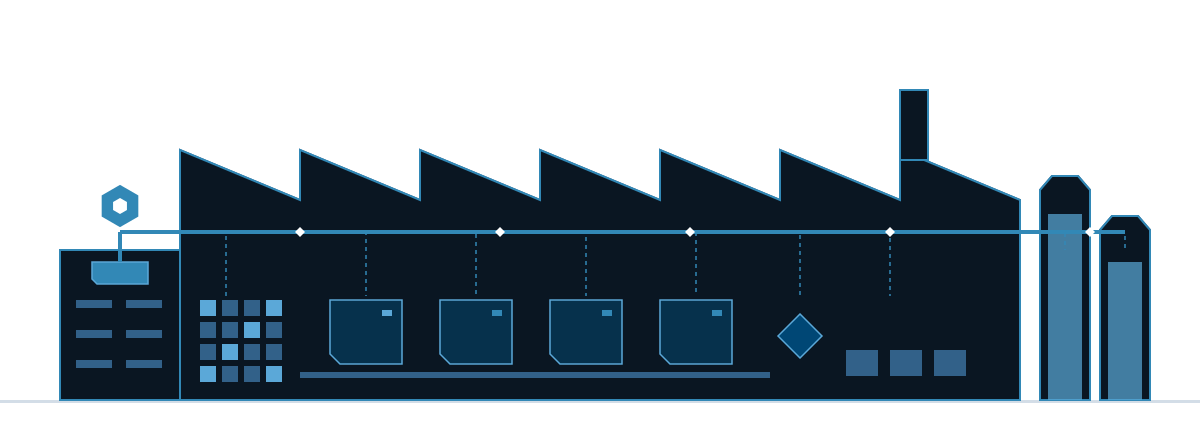
Manufacturing signal map
Finance + operations + IT
ERP
Finance and procurement signals
Plant
Operations, quality, and yield context
BI
Power BI and executive reporting layers
Dallas credibility, national manufacturing reach
Practical AI for manufacturers from the ITECS team in Dallas.
ITECS AI is backed by ITECS, a Dallas-based MSP operating since 2002. The manufacturing offer is not limited to local companies; Dallas is the operating base behind the IT, cybersecurity, infrastructure, and managed-service discipline that production AI needs.
Read the historical Pegasus Foods manufacturing case summaryOperating pressure
Manufacturing AI Starts With Margin, Throughput, and Risk
The first step is not picking a model. It is identifying the operating decisions where finance and plant signals are late, fragmented, or too manual to trust at speed.
Finance pressure
Manufacturing finance teams are asked to explain margin movement while commodity costs, supplier terms, freight, mix, and customer programs move faster than month-end reporting.
- Purchase price variance and commodity swings
- Working capital tied up in raw, WIP, and finished inventory
- Customer chargebacks, rebates, and pass-through leakage
- SKU, plant, customer, and program margin erosion
Operations pressure
Plant leaders manage uptime, changeovers, yield, quality holds, labor gaps, and schedule volatility with data that often lives outside the finance view.
- Machine downtime, maintenance risk, and changeover losses
- Scrap, rework, spoilage, and quality investigations
- Production schedule volatility and labor constraints
- Warranty, field issue, and supplier quality patterns
Data pressure
AI only becomes useful when ERP, BI, plant, quality, contract, and supplier data can be trusted, governed, and connected to the decisions executives already own.
- Discrete manufacturing parts, routings, suppliers, and warranty data
- Process manufacturing formulas, BOMs, lot traceability, and quality records
- ERP, BI, spreadsheets, contracts, and market data
- Role-based access, audit logs, and human approval boundaries
Example CFO signal board
The Metrics a Manufacturing AI System Should Make Visible
A finance-led manufacturing AI program should give executives a daily view of margin exposure, recoverable cost movement, cash tied up in inventory, and operational risk. These example figures are illustrative; discovery replaces them with the client's actual ERP, BI, contract, and plant data.
Exposure bridge
PPV and margin drivers
Projected PPV exposure
$1.84M
Next 90 days against current standards
Recoverable pass-through
$510K
Variance tied to customer escalator language
Inventory cash at risk
$3.2M
Aging, excess, and commodity-sensitive positions
Margin protected
1.1 pts
Modeled impact of approved actions
What leadership sees
- Ties PPV to SKU, plant, customer program, and contract terms
- Separates true margin erosion from recoverable customer pass-throughs
- Routes purchase, hedge, and standard-cost recommendations for approval
Manufacturing use cases
Where AI Creates Measurable Value
Start with the operating questions where better signals change a finance, operations, quality, or supply-chain decision.
Featured first use case
PPV Agent: Purchase Price Variance and Commodity Cost Intelligence
The first detailed manufacturing use case focuses on a CFO-owned problem with measurable economics: explaining what changed in material cost, what exposure is coming next, and which actions need approval.
Turn PPV from a close artifact into a forward risk signal.
The PPV agent connects procurement transactions, standards, BOMs or formulas, contract terms, and reporting context so finance can decompose variance, identify recoverable pass-throughs, and see forward exposure before month-end.
Start here
Manufacturing AI Readiness Assessment
ITECS starts by mapping the business case, data readiness, integration path, and governance model before recommending an agent build.
Map executive priorities
Identify the finance, operations, quality, supply chain, and IT decisions where better signals would change action.
Review the data landscape
Assess ERP, BI, plant, quality, procurement, contract, and spreadsheet sources for ownership, cleanliness, access, and gaps.
Rank use cases by economics
Prioritize use cases by measurable margin, working capital, throughput, risk reduction, and implementation feasibility.
Define the governed path
Document security, approval, audit, deployment, and support requirements before any production AI system is built.
Governance
Built for Manufacturing Controls
ITECS designs manufacturing AI around the client's existing IT, security, approval, and finance control boundaries.
Read broadly, act carefully
Manufacturing AI can read across systems, but sensitive actions need explicit human approval and audit history.
- No autonomous purchasing, hedging, journal entries, or master-data changes
- Role-based access aligned to the client's identity provider
- Recommendation logs that preserve assumptions, source data, and reviewer decisions
Built for IT reality
ITECS designs around the systems manufacturers already run, from ERP and BI to plant data and Microsoft 365.
- Cloud, hybrid, and Microsoft-stack deployment patterns
- Integration-first discovery before custom development
- Ongoing managed AI operations available after launch
Security
Security for Manufacturing AI Workflows
Manufacturing AI can touch financial data, ERP records, supplier terms, plant signals, quality records, and customer contracts. ITECS designs these systems with scoped access, audit logs, and human approval before sensitive actions.
FAQ
Manufacturing AI FAQ
What types of manufacturers can use ITECS manufacturing AI services?
ITECS works across discrete and process manufacturing. The hub examples cover parts, machines, suppliers, production schedules, formulas, BOMs, lot traceability, quality holds, commodity exposure, and customer contracts.
Is this only for manufacturers in Dallas?
No. The offer is national. Dallas is used as a credibility signal because ITECS is a Dallas-based MSP with more than two decades of infrastructure, cybersecurity, and operations experience.
Do we need a clean data warehouse before starting?
No. The readiness assessment determines whether existing ERP, BI, spreadsheet, contract, and plant data is enough for a pilot or whether data cleanup must happen first.
Can ITECS work with our ERP and Power BI setup?
Yes. ITECS evaluates the client's ERP, BI, and reporting architecture during discovery. Microsoft-stack BI, SQL-backed systems, and common ERP reporting patterns are plausible starting points; compatibility is confirmed rather than inferred from a vendor name.
What is the best first AI use case for a manufacturer?
The best first use case is the one with clean enough data, an executive owner, and measurable economics. For many finance-led manufacturers, PPV and commodity cost intelligence are strong first candidates.