01
Governance
Teams adopt tools faster than leadership can set policies.
ITECS defines approved use cases, data rules, human review paths, and operating ownership before AI spreads.
Data Readiness Sprint
Prepare one department or use case for a reliable AI build with source inventory, permission review, folder or library restructuring, metadata and naming hygiene, and ingestion preparation.
Reliable AI starts with build-ready source material. The AI Data Readiness Sprint audits and cleans the document corpus for one department or use case, reviews permissions, restructures folders or libraries, improves metadata and naming hygiene, and prepares the approved sources for ingestion.
The Stakes
Most organizations do not need another disconnected AI experiment. They need a managed operating model that tells people what is approved, where data can go, which workflows deserve investment, and who owns reliability after launch.
ITECS Position
Managed Intelligence applies ITECS's 24-year managed IT and cybersecurity operating model to AI systems, prompts, agents, connectors, and employee adoption.
Teams adopt tools faster than leadership can set policies.
ITECS defines approved use cases, data rules, human review paths, and operating ownership before AI spreads.
Sensitive data moves into public prompts, unmanaged plugins, and disconnected workspaces.
ITECS brings managed-IT discipline to access, identity, data handling, and vendor selection.
AI experiments consume subscriptions and meetings without a measurable operating case.
ITECS starts with workflows, cost of delay, and measurable outcomes before recommending build work.
Useful pilots stall when they have to connect with Microsoft 365, CRM, service, or finance systems.
ITECS designs automation around the systems, permissions, approvals, and support model already in place.
Illustrative Planning Signal
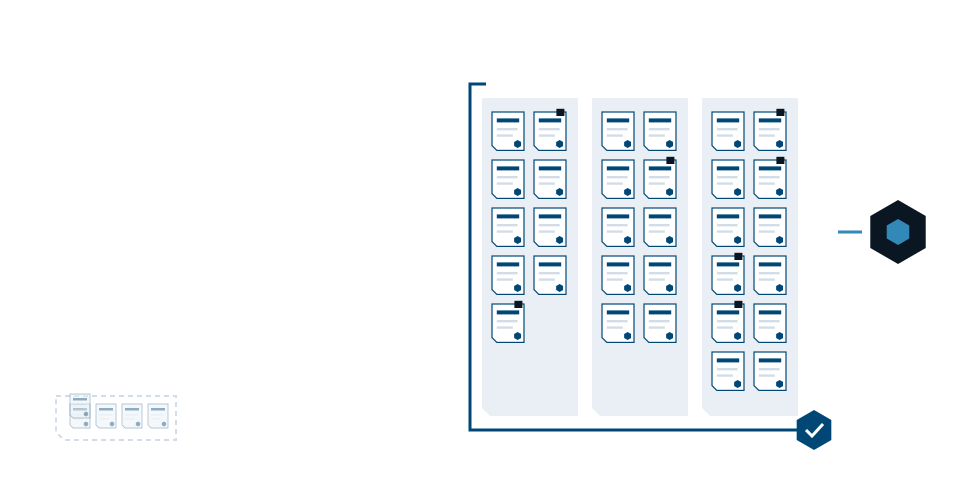
Useful business knowledge is often spread across duplicated folders, inconsistent names, stale documents, and permissions that were never designed for an AI workflow. A build cannot be reliable when its source set is unclear.
The Data Readiness Sprint concentrates on one department or use case. ITECS inventories the corpus, reviews access, organizes the relevant libraries, improves metadata, and prepares approved sources for ingestion before engineering begins.
Illustrative Planning Scenario
This modeled example shows how an engagement could be scoped; it is not presented as a reported client result.
A growing operations team: has the documents an agent needs, but the approved versions are mixed with duplicates, inconsistent permissions, and folders that reflect years of ad hoc storage.
Modeled outcome: The sprint creates a governed source set and a written readiness decision, giving the build team a dependable starting point instead of discovering data problems during implementation.
Capabilities
We identify the approved sources for one department or use case, map ownership, and document the material the proposed AI workflow is expected to use.
We review access, restructure the relevant folders or libraries, and improve metadata and naming so the source set is consistent and governable.
We prepare the approved source set for ingestion and confirm in writing whether it is build-ready. Any remaining readiness work is identified before engineering begins.
Audit Process
Inventory
Approved sources and owners
Review
Permissions for the workflow
Organize
Folders and libraries
Normalize
Metadata and naming
Prepare
Ingestion-ready source set
Security
Your source material stays governed throughout the engagement. ITECS AI is backed by ITECS — a Dallas-based cybersecurity MSP operating since 2002. For ongoing protection beyond the audit, the ITECS cybersecurity team delivers endpoint detection, managed firewalls, email security, and penetration testing for businesses across Dallas–Fort Worth.
Pricing
The sprint turns an uncertain document corpus into a defined, governed source set for one department or use case.
Planning comparison only. Scope, timing, and outcomes vary by data, workflow, approvals, adoption, and implementation conditions.
Outcome hypothesis to validate
Data Readiness Sprint prepares one department or use case for a reliable build before engineering begins.
This is not a reported client result or guarantee. Baseline the current workflow and measure accepted work before relying on it.
Transparent Pricing
Prepare one department or use case for a reliable build before engineering begins.
A document-corpus audit and cleanup that prepares business sources for a reliable agent or AI workflow.
One department or use case
Every build proposal either includes a data-readiness line item or confirms in writing that sources were verified build-ready during discovery.
Get StartedEngagement Targets
Illustrative targets to baseline and validate during discovery — not reported client results or performance guarantees.
FAQ
The Data Readiness Sprint is $3,500–$8,500 for one department or use case. It includes source inventory, permission review, folder or library restructuring, metadata and naming hygiene, and ingestion preparation.
ITECS uses client-managed, least-privilege credentials for the specific sources in scope. Access and any required changes are agreed before work begins; the sprint does not require unrestricted access to the client's full environment.
ITECS documents the approved vendors, plan-level data-use and retention terms, tenancy, access, and any required data movement before work begins. Client-managed least-privilege access is used for in-scope sources, and a DPA is available on request.
Every build proposal either includes a data-readiness line item or confirms in writing that sources were verified build-ready during discovery.