AI-Optimized SEO
AI-Optimized SEO Services in Dallas
Strengthen how Dallas buyers and answer engines discover, understand, and verify your business with sound technical SEO, useful content, and measurable AI-search visibility.
Definition
What is AI SEO?
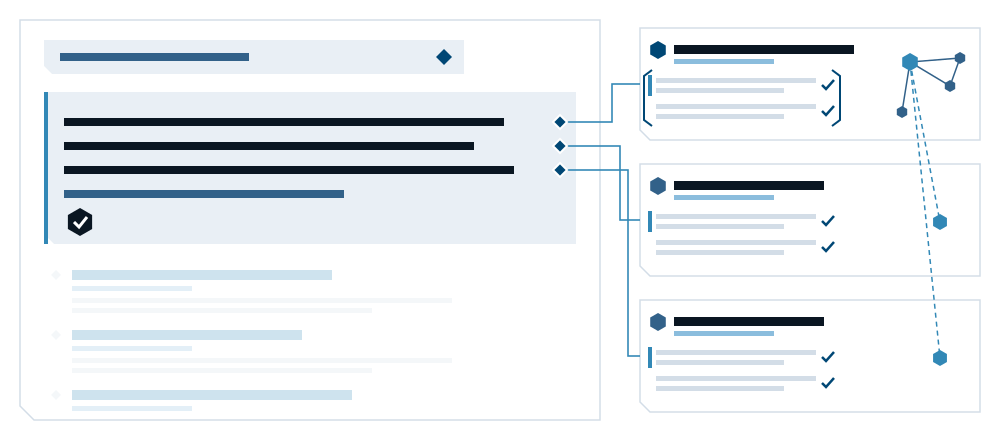
AI-optimized SEO, sometimes called generative engine optimization (GEO), applies durable search fundamentals to AI-assisted discovery. It makes your public pages crawlable, clear, useful, and well supported so search systems and people can understand your services. No special file, schema type, writing formula, or page structure guarantees a ranking, mention, recommendation, or citation.
How It Works
How AI-Assisted Discovery Works
A practical model for improving eligibility and measuring results without pretending to control an answer engine.
Step 1
Crawl and Retrieval Eligibility
Search systems need to reach the canonical page, render its useful content, and understand its basic purpose. Technical SEO, descriptive internal links, and consistent business details support that access. Accurate structured data can clarify visible facts, but it is not a ranking or citation switch.
Step 2
Source Selection and Corroboration
Some AI experiences retrieve current web sources; others use different systems and indexes. Clear first-party facts, useful evidence, and consistent third-party references can make a page easier to evaluate. An llms.txt file is optional documentation and is not a Google Search requirement or a guarantee of ingestion.
Step 3
Response Synthesis
An answer engine may synthesize multiple eligible sources based on the query and its own systems. We make claims specific, source-backed, and easy to verify, then measure actual mentions, citations, referral sessions, and conversions. The platform—not ITECS—decides what appears.
The Shift
Traditional SEO vs AI-Optimized SEO
AI discovery adds another measurement surface; it does not replace traditional search fundamentals.
Philosophy
Clean SEO Philosophy
We refuse the tactics that look fast and break things later. We invest in the work that compounds.
What We Refuse
- Paid link placement, link farms, or reciprocal link schemes
- Short-term hacks that trigger Google penalties
- Keyword stuffing that hurts user experience
- Generic SEO packages with no AI visibility strategy
What We Do Instead
- Technical SEO fixes that help search systems crawl and interpret pages
- Semantic HTML and content architecture for topical authority
- Accurate schema markup when it matches visible content and a real use
- Performance tuning that improves Core Web Vitals
- Content built around real search demand, not fluff
Scope
What AI-Optimized SEO Includes
Two layers of work running in parallel — the traditional SEO foundation search systems rely on, plus AI-discovery measurement and source clarity where evidence supports it.
Traditional SEO Foundation
- Technical SEO audit and remediation (site speed, crawlability, mobile)
- Keyword research and content strategy aligned to business goals
- On-page optimization for titles, headers, and internal linking
- Local SEO targeting Dallas–Fort Worth corridors
- Content architecture that builds topical authority
AI Discovery Layer
- Optional llms.txt documentation when a named consumer or business use justifies it
- Accurate Schema.org JSON-LD that matches visible entities and offers
- Clear semantic page structure for readers, crawlers, and assistive technology
- Source, entity, and citation-readiness review across relevant platforms
- AI-search visibility baselines for AI Overviews, ChatGPT, Perplexity, and Bing
How It Works
Our Process: Widest Net + Sharp Hooks
A four-step engagement that anchors on broad Dallas demand and proves industry-specific expertise in the same content.
Step 1
Audit & Intelligence
We analyze GA4, Search Console, crawl health, and Core Web Vitals to identify technical blockers and AI visibility gaps.
Step 2
Widest Net Targeting
We anchor on high-volume Dallas SEO phrases while mapping nearby demand in Uptown, Plano Legacy West, Las Colinas Corporate Center, Downtown Dallas Legal District, and the Richardson Telecom Corridor.
Step 3
Sharp Industry Hooks
We explain the products, standards, evidence, and workflows buyers actually need, using the language your subject-matter experts and customers can verify.
Step 4
Measure & Iterate
We track rankings, AI referral sessions, and conversion paths to keep content, entities, and citations compounding over time.
Under the Hood
Technical Foundation
The infrastructure layer that supports crawlability, page understanding, measurement, and a stable buyer journey.
- ▸Schema.org + JSON-LD Graphs
- ▸Core Web Vitals
- ▸Canonical + Sitemap Governance
- ▸OpenGraph + Social Metadata
- ▸Optional LLM Documentation (when justified)
- ▸Semantic Heading Architecture
- ▸GA4 + Search Console Instrumentation
- ▸Citation-Ready Content
Pricing
Engagement Options
Three ways to engage — pick the tier that matches your growth ambition.
SEO Foundation
One-time technical and AI-readiness project.
From $4,500 · one-time
- Technical audit + remediation
- Accurate schema + optional LLM documentation
- Semantic + local content architecture
- Prerequisite for Momentum & Velocity
SEO Momentum
Monthly managed SEO with AI visibility tracking.
$1,750 / month · month-to-month
- 2 articles + AI visibility audits
- 15–30 keywords tracked monthly
- 1 itecsonline.com editorial feature
- Two 30-min strategy calls per month
SEO Velocity
Premium retainer for aggressive growth.
$3,500 / month · 6-mo minimum
- 4 articles + 2 editorial features + 3rd-party PR
- 50–75 keywords + monthly AI visibility
- Competitor monitoring + quarterly CRO
- Weekly strategy calls + dedicated AM
Why ITECS for AI-Optimized SEO
ITECS AI is the AI division of ITECS — a Dallas managed IT and cybersecurity firm operating since 2002. We do not outsource technical work. Crawlability, accurate schema, Core Web Vitals, and AI visibility audits are run by the same engineers who manage enterprise infrastructure for Dallas businesses.
Learn more about ITECSGlossary
AI-SEO Knowledge Base
Plain-English definitions for the terms that come up in AI-optimized SEO conversations.
- Generative Engine Optimization (GEO)
- The practice of optimizing content specifically for AI-powered search engines (like ChatGPT Search, Google AI Overviews, and Perplexity) rather than just traditional blue links.
- Large Language Model (LLM)
- AI systems like GPT-4, Claude, and Gemini that are trained on vast amounts of text data to understand and generate human-like language.
- Retrieval Augmented Generation (RAG)
- A technique where an AI model looks up specific, up-to-date information from a trusted external source (like your website) before generating an answer, reducing errors.
- Knowledge Graph
- A structured database of facts (entities) and the relationships between them. Google and AI models use this to understand that "ITECS" is a "Company" located in "Dallas".
- Zero-Click Search
- A search result that provides the answer directly on the results page (via a featured snippet or AI overview), so the user doesn't need to click a link.
- Neural Information Retrieval
- Search technology that uses neural networks to understand the meaning behind a query (semantics), rather than just matching keywords.
FAQ
AI-Optimized SEO FAQ
How is AI SEO different from traditional SEO?
AI SEO keeps the same crawlability, content quality, technical, and authority fundamentals as traditional SEO, then adds measurement for AI-assisted discovery and extra attention to source clarity. Structured data can describe visible facts, but no special markup or writing format makes an AI system recommend a business.
Will AI SEO work for my specific industry (legal, manufacturing, etc.)?
Yes. Regulated industries often benefit the most because AI systems prioritize trust signals (experience, expertise, and verifiable credentials). We highlight your industry-specific proof and structure it so search engines and AI models understand it clearly.
Does ITECS use AI to write the content?
We use AI for analysis (gap detection, intent mapping, and opportunity research), but strategy and publishing are led by humans. We do not ship unreviewed AI text; quality, accuracy, and usefulness come first.
Will this help with Google AI Overviews and AI citations?
It can improve the technical eligibility and source clarity that search and AI systems may use. We also measure actual visibility and referral evidence. Google and AI platforms control their results, so ITECS cannot guarantee an Overview, mention, ranking, recommendation, or citation.
Do you build backlinks or run link schemes?
No. ITECS avoids paid link placement, link farms, and other risky tactics. We focus on on-page optimization, technical SEO, and authoritative content that earns sustainable rankings.
What do we receive from an AI-SEO audit?
You receive a prioritized roadmap covering technical fixes, content architecture, entity gaps, schema enhancements, and AI discovery improvements based on GA4, Search Console, and Core Web Vitals.
How long does it take to see results?
There is no fixed ranking or citation timeline. We establish a baseline, ship the agreed technical and content work, and review crawl, visibility, referral, and conversion evidence on the reporting cadence. Competition, demand, platform changes, and current site health all affect outcomes.
Can you target Dallas–Fort Worth and my industry at the same time?
Yes. We use a widest-net strategy for Dallas SEO visibility while adding industry-specific hooks (tools, compliance terms, and workflows) to prove expertise and capture qualified traffic.
Where do the three tiers fit (Foundation, Momentum, Velocity)?
Foundation is a one-time project that fixes technical SEO and content architecture. Momentum is the monthly retainer that keeps the foundation healthy and adds content, AI visibility tracking, and one disclosed ITECS editorial feature per month. Velocity doubles content cadence and editorial features, then adds earned third-party outreach, competitor monitoring, and quarterly CRO. Foundation is a prerequisite for Momentum and Velocity.