Updated August 31, 2026: Client-like scenarios in this guide are now explicitly illustrative, implementation schedules are dependency-based, and production controls are presented as requirements to verify rather than guaranteed outcomes.
Agentic AI workflows are autonomous, multi-step systems that finish business work — invoicing exceptions, candidate screens, supplier risk reviews — without a human clicking through every step. Dallas enterprises are moving them from pilot to production this year because they handle the long-tail decisions chatbots cannot answer and the policy-bound exceptions that legacy automation rejects.
The fastest path from agentic pilot to durable production is to pair the build with a Managed Intelligence Provider that owns governance, observability, and rollout discipline. Most pilots stall because no one owns the operational layer. ITECS has run that layer for traditional IT systems for 24 years and now applies the same discipline to enterprise agentic AI workflows.
What An Agentic AI Workflow Actually Is
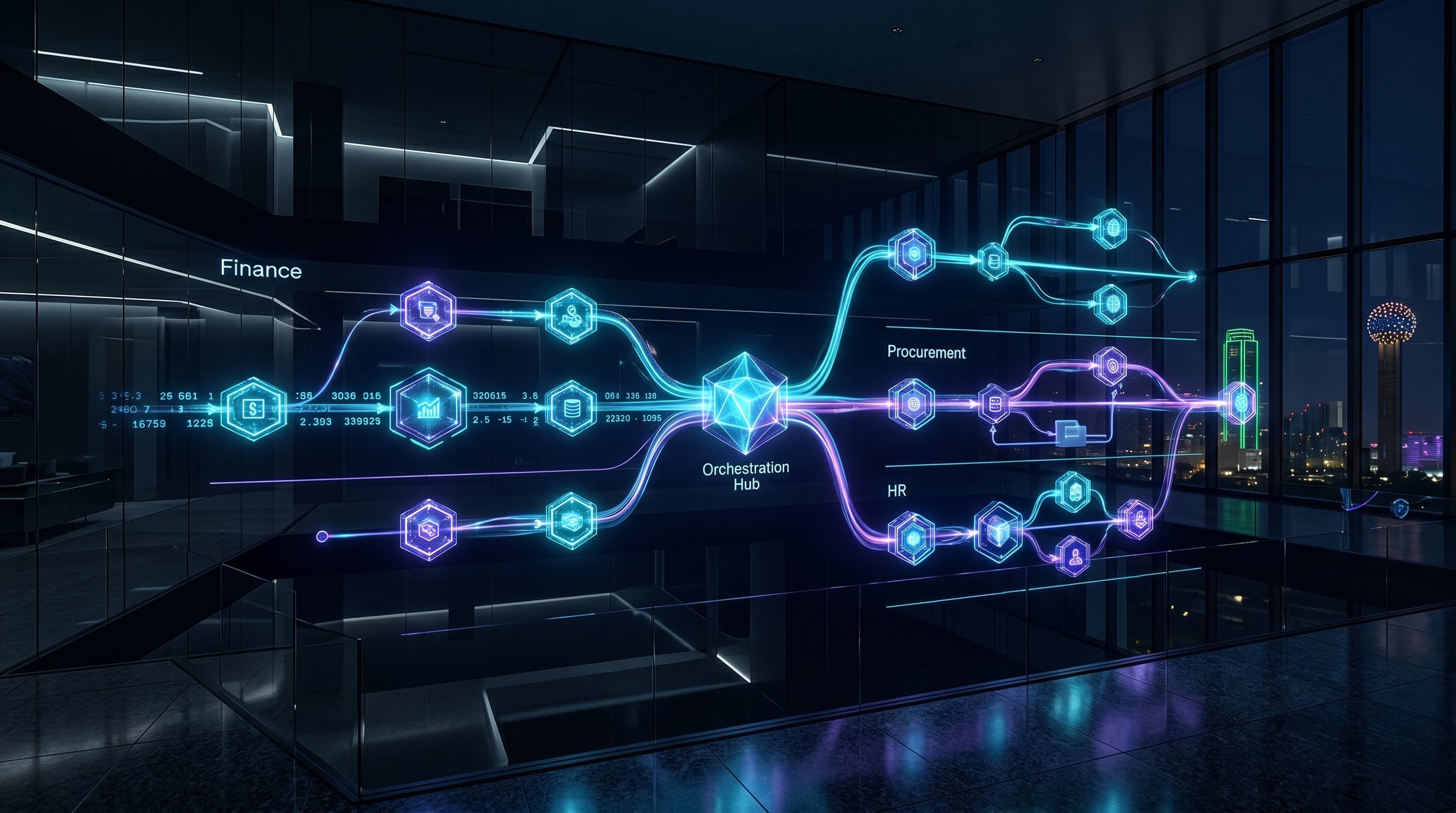
An agentic workflow is software that plans, decides, and executes a multi-step business task on its own. It pulls data from your CRM, looks up a policy in your knowledge base, drafts a response, posts to an approval channel, waits for human signoff when policy requires it, and updates your system of record. A chatbot answers questions. A traditional automation runs a fixed script. An agentic workflow makes the judgment calls in between.
The architecture has three layers. A planner model breaks a goal into steps. Tools connect to business systems through the Model Context Protocol. A governance layer logs every decision and stops the agent when policy thresholds are crossed. Most enterprise builds use Claude, GPT-class models, or Azure OpenAI for the planner. Tools usually reach into HubSpot, Salesforce, NetSuite, Workday, ServiceNow, SAP Concur, DocuSign, Microsoft 365, Slack, Jira, and internal SQL databases.
The Pilot-To-Production Trap
Most enterprise agentic AI pilots stall at the same point. A small team builds an impressive demo in three weeks, leadership greenlights production, and everything stops. The integrations need credentials. The audit logs need a destination. The exceptions need a workflow. The risk team needs a control framework. The model needs version pinning. Nobody owns this gap, so the pilot dies in committee.
Consider an illustrative accounts-payable pilot that reads supplier invoices, matches them to purchase orders, and routes exceptions. Moving it to production can introduce requirements such as audit evidence, dual approval above a company-defined threshold, vendor-master controls, payment segregation, reversal procedures, and controller review. The schedule depends on those controls and integrations; a successful historical-data demo does not establish production readiness.
A Four-Stage Blueprint For Pilot To Production
ITECS uses a four-stage rollout that prevents the production trap. Each stage has an owner, a gate, and a deliverable.
Stage 1: Foundation audit. Before agent code is written, map every input, decision, output, and exception. Identify read and write systems, credentials, rate limits, audit destinations, policies, and thresholds. Produce a workflow specification and access matrix. The schedule depends on process complexity, data quality, and stakeholder availability and may feed into a formal data audit.
Stage 2: Sandbox pilot. Use an isolated environment with approved read-only datasets and write access only to staging. Select enough representative normal, edge, and adversarial cases to support the release decision. Measure goal completion, correctness, exception rate, unsafe actions, latency, and cost. Tune until the predefined thresholds are met; do not commit to a duration before the test corpus and integrations are known.
Stage 3: Guardrails and governance. Wire the agent into your existing identity provider, audit log pipeline, secrets manager, and approval channels. Set policy thresholds that route any decision above a defined dollar amount, risk score, or sensitivity classification to a human reviewer. Pin the model version. Define the rollback procedure. Document the human approval path for each exception class. This stage maps directly to the NIST AI Risk Management Framework and produces the control evidence your auditors will ask for.
Stage 4: Production rollout and continuous tuning. Launch against a constrained slice of real work and compare it with the approved baseline or parallel human handling. Expand only when gates pass. Set review and model-change schedules according to risk, observed drift, vendor changes, and incident history rather than a universal calendar.
Where Agentic AI Pays Off Fastest In Enterprise Operations
Three operating functions tend to absorb agentic AI workflows first because they carry the highest ratio of repeatable judgment calls to original creative work.
Finance and accounting. Candidate tasks include invoice triage, expense review, journal-entry preparation, reconciliation support, vendor monitoring, and close support. Keep posting, payment, and exception authority with accountable finance owners until evidence supports a narrower delegation. Lenders and credit teams can apply the same control pattern to AI agents for financial services.
Procurement and supply chain. Candidate tasks include supplier intake, clause extraction, RFP triage, purchase-order drafts, delivery exceptions, and supplier-risk research. Verify sanctions and legal findings against authoritative sources, preserve evidence, and require approval before supplier or payment changes. Manufacturers can apply this pattern through the purchase price variance agent and broader manufacturing AI agent portfolio.
Human resources and talent operations. Candidate tasks include rubric-based intake, onboarding orchestration, benefits-question retrieval, and policy assistance. Preserve employment-law review, accessibility, employee privacy, and human responsibility for consequential decisions. Approved answers can feed an AI knowledge base through a correction and renewal process.
Security, Governance, And Compliance Discipline
Agentic AI workflows touch real business systems with real consequences. ITECS uses the NIST AI Risk Management Framework as a voluntary governance reference and maps additional legal, contractual, security, and industry requirements to the actual workload.
Concretely, that means every agent has a documented purpose, a defined input and output schema, an identity-bound credential model, an immutable audit log, a model version pin, a human approval path for high-impact actions, a rollback procedure, and a quarterly governance review. Sensitive data flows through Azure OpenAI on a private endpoint or through an equivalent governed runtime — never through a consumer AI tool. For regulated industries, ITECS configures DLP policies that block PHI, PII, payment data, and privileged legal content from leaving the agent's permitted scope.
The right way to think about agentic AI security is the way a 24-year-old Dallas managed IT firm thinks about user account management — least privilege, full logging, regular review, and clear ownership of every credential. Agents are simply another class of identity that needs governance.
Pricing And ROI For Enterprise Agentic AI Workflows
ITECS prices agentic AI workflow builds in governed phases, with discovery credited toward the build and production operations separate after launch. Agent Discovery & Technical Specification is $4,500–$7,500; Proof of Concept / Prototype is $8,000–$18,000; Single-Workflow Production Agent is $18,000–$35,000; Integrated / Line-of-Business Agent is $35,000–$75,000; and Multi-Agent System / AI-Augmented Process Redesign is $55,000–$120,000. Agent Operations is $2,500/mo for one production agent, $4,500/mo for two, and $6,500/mo for three; larger or more demanding footprints are custom-quoted. The full fee schedule is published on our pricing page.
Calculate ROI from the measured baseline: accepted work completed, human review and correction, errors, cycle time, operating cost, incidents, and capacity actually redeployed. Do not assume that adding suppliers or business units preserves the same economics, or that risk reduction equals cash savings. Our CEO guide to AI ROI explains the calculation.
What governs the math is whether your business already carries the data, identity, and integration discipline to absorb an agent. Companies that do not should start with a structured data and AI readiness audit before scoping any agentic build. Companies that do can move directly to a custom AI agent build, pair it with workflow automation for the surrounding routing work, and back it with employee AI training so the workflow's human reviewers operate the agent confidently from day one.