
Budget an AI pilot around the cost of work your team can actually use. A low model bill can sit alongside hours of checking drafts, fixing material errors and sending difficult cases to specialists. Those hours determine whether the team can handle the workload and whether the workflow earns its place in the budget.
Start with a workflow you can measure, such as preparing invoices for review. Define a successful outcome before testing. For example, the supplier, purchase order, totals and invoice lines must match the evidence, and the finished record must be ready by the posting cutoff. Measure the current manual workflow against the same standard so finance has a comparable baseline.
What READY measured alongside accuracy
The September 2026 preprint READY or Not evaluates a workflow with its oversight policy in place. The authors use development cases to choose a rule for which outputs to accept and which to send to a reviewer. They freeze that rule and assess it on held-out cases. A policy qualifies when the lower confidence bound for reliability clears the target under the study’s assumptions.
In the retrospective clinical-audit case study, two systems had autonomous success rates of 72.8% and 72.5% on development cases. On the held-out cases, their selected policies routed 39.2% and 29.6% to human review, respectively, and both qualified against a 76% reliability target. The 90% success rate for human review was a modeling assumption. Those figures describe the clinical benchmark and its policies. Use your own workflow data to set a quality target and estimate how often your reviewers catch and resolve errors.
An executive scorecard for the pilot
Use one record per eligible task and capture the original output, routing decision, final disposition and active staff time. Sample automatically accepted work as well as reviewed work so your quality estimate includes errors that might otherwise pass unnoticed. Track queue wait separately from active minutes because both affect whether the work meets its deadline.
- Accepted work
- Count tasks that meet the pre-agreed quality and turnaround standard. Break out accepted as submitted, accepted after correction and accepted after escalation. Report against all eligible tasks, including unresolved cases.
- Corrections
- Count tasks needing edits, identify material versus cosmetic changes and record active correction minutes. Include cases a reviewer checks and approves without edits in the review-time log.
- Escalations
- Record how often cases move to a specialist, why they were routed, who resolves them and how long the handoff takes. Count each task once in the escalation rate and record every person’s time.
- Review effectiveness
- Have a second reviewer independently score a sample of both reviewed work and automatically accepted work. Record missed material errors, reviewer disagreements and the types of cases that require more scrutiny.
- Total effort and cost
- Sum human minutes by role across review, corrections, escalations, manual completion and quality sampling. Add software, integration support and operating overhead. Divide the total cost by the count of accepted tasks.
Break results down by the kinds of cases that matter to the workflow. A common invoice layout may need a quick check while a partial shipment takes a specialist ten minutes to reconcile. A single average can hide the case type that fills the queue at month-end. Record peak volume, available reviewer hours and the percentage of tasks completed by the cutoff.
Work the cost per accepted task
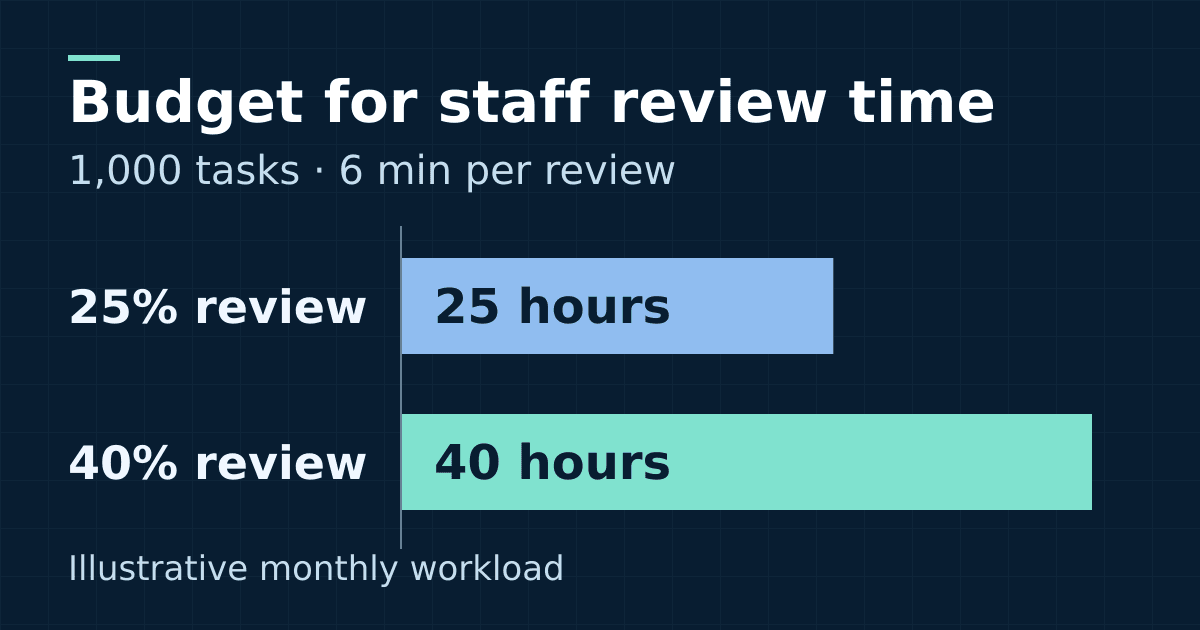
Suppose two options each process 1,000 invoices in a month and produce 970 accepted invoices at the same quality and deadline. These are illustrative numbers. Both have $300 in monthly operating overhead. In this simplified example all staff effort is included in the review time, which averages six minutes per routed invoice at a fully loaded labor rate of $45 an hour.
Option A. At $0.70 in software cost per invoice, 250 reviews take 25 hours. The month costs $700 for software, $1,125 for labor and $300 for overhead. The total is $2,125, or $2.19 per accepted invoice.
Option B. At $0.35 in software cost per invoice, 400 reviews take 40 hours. The month costs $350 for software, $1,800 for labor and $300 for overhead. The total is $2,450, or $2.53 per accepted invoice.
Option B saves $350 on software and adds $675 in reviewer time. For a real pilot, include staff time spent on the cases that fail or are abandoned, and budget separately for implementation and training. Compare ongoing cost per accepted invoice with the manual baseline. Use measured review rates and handling times to model a peak month and see whether the review queue still clears by the cutoff.
Decide when the pilot has earned a rollout
Before tuning, agree on a minimum acceptable quality level, a maximum rate of serious errors, a turnaround target and a cost ceiling. Pick the review rule on a development sample, then hold it steady on fresh cases. Have the pilot owner and finance lead review outcomes, uncertainty and peak staffing together. If the evidence is thin or the queue exceeds available capacity, keep the pilot bounded while you collect more representative cases or revise the review rule.
Once the workflow meets the agreed bar, repeat the check when a model, policy or input mix changes. Feed the measured cost and capacity into the business case for AI ROI so the next budget includes the people who will keep the work moving.
