
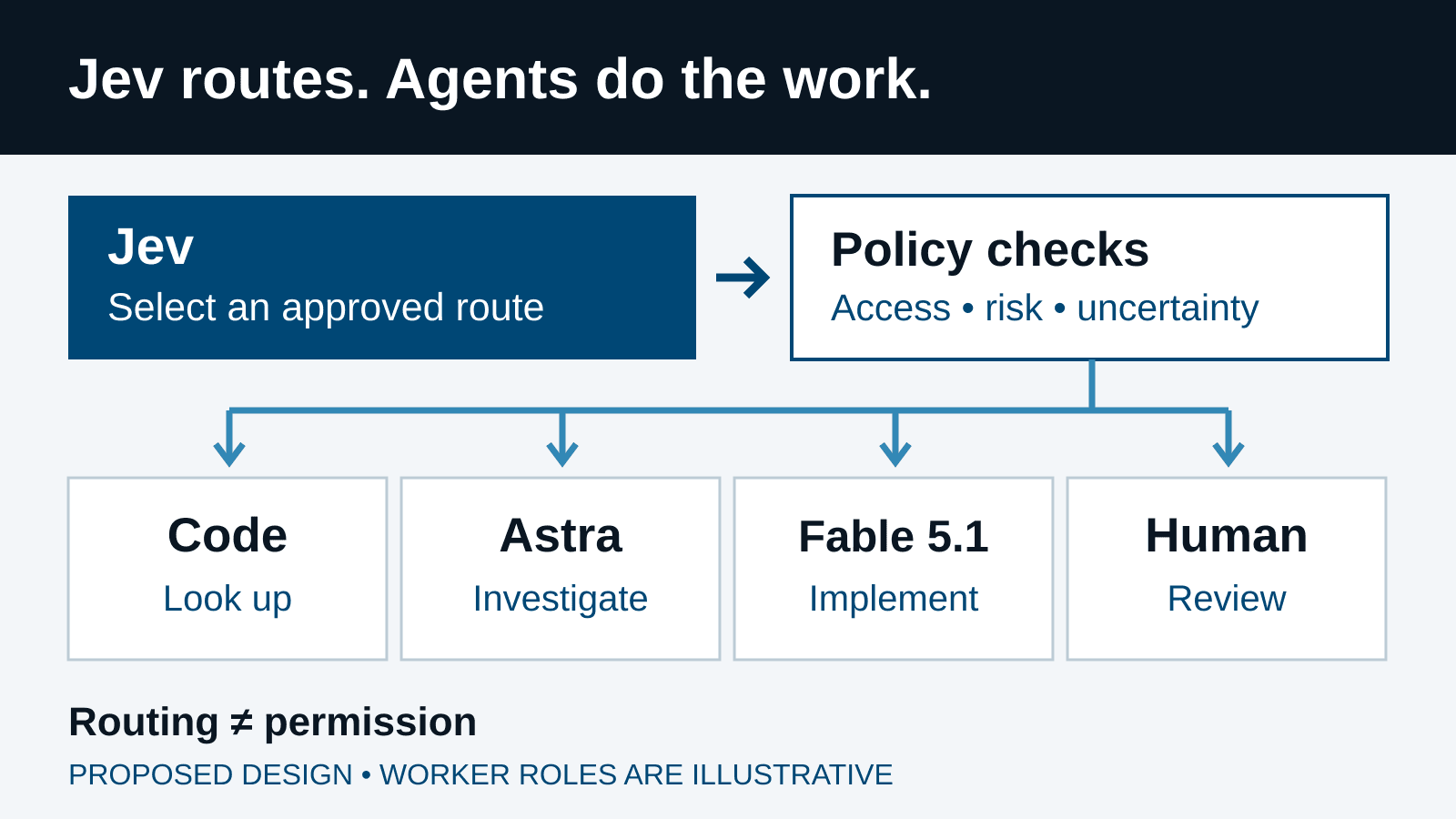
An AI agent does not need to write an essay to decide which queue should receive a support request. That is the opportunity behind Jev: use a constrained decision model for routing, then reserve a general-purpose model for the work that needs explanation, research, or code. For business leaders, the useful question is not whether Jev replaces Astra or Fable 5.1. It is whether adding a router improves completed work enough to justify another dependency.
TypeSafe AI introduced Jev in early access on September 15, 2026. Its launch announcement describes a System One Model that gives up string generation and returns predefined, typed decisions. The company reports 70–500 milliseconds end-to-end latency, with published evaluations generally run near its US West Coast service. Those are vendor measurements, not a service-level guarantee or an ITECS benchmark.
What Jev does—and what it does not
TypeSafe's API introduction describes three primitives: Choice selects from named options; Score evaluates a defined scale; Noul estimates whether a statement holds. Choice and Score include distributions and confidence. Multiple questions can run together, but each evaluates the same supplied state independently. An answer to one question does not become evidence for another inside that call.
Think of a business application asking: Which approved department owns this request? How urgent does the described problem appear? Is the information sufficient for a first assessment? The application supplies the categories and relevant facts. Jev supplies decisions within that structure. The surrounding software still owns retrieval, authentication, tool execution, and the final response. If the job is to draft a contract explanation or implement a feature, classification alone cannot finish it.
Does Jev really have no hallucinations?
TypeSafe's zero-hallucination presentation needs a narrow reading. The launch explicitly says its plotted zero is not an empirical measurement: it is based on guaranteed schema matching. That does not establish that a selected category is factually correct. A model can return a perfectly valid billing label for a security incident. It has obeyed the output contract and still made the wrong business decision.
1. Valid output?
The label belongs to the allowed set.
Check the output contract.
2. Correct decision?
The label fits the actual request.
Test against reviewed cases.
3. Authorized action?
This user and worker may perform it.
Enforce permissions and approvals.
This distinction changes the deployment decision. Removing invented labels is valuable; removing the need to test decisions would be a much stronger claim. Do not treat a constrained output, a high confidence value, or agreement between models as proof that a payment, disclosure, or production change is appropriate.
Jev vs GPT-6 Astra vs Claude Fable 5.1
OpenAI documents Astra for complex reasoning, coding, research, computer use, and document creation; it supports function calling and structured outputs too. Anthropic positions Fable 5.1 for coding, knowledge work, and long-running tool-based tasks. Neither is limited to the illustrative assignment below. Select a worker using your own task results, not a fixed assumption that one brand always handles a particular profession better.
SELECT
Jev
- Output
- Constrained choices and scores
- Example role
- Choose an approved route
- Boundary
- Does not write the final explanation or code
REASON + PRODUCE
GPT-6 Astra
- Output
- Text, code, and tool-based work
- Example role
- Investigate and develop a supported answer
- Boundary
- Structured output is supported; correctness still needs checking
REASON + PRODUCE
Claude Fable 5.1
- Output
- Text, code, and tool-based work
- Example role
- Investigate and implement a bounded assignment
- Boundary
- Do not assume superiority for a task without testing
The comparison is about roles, not a measured performance ranking. TypeSafe's workflow evaluation site averages results across security incidents, agent traces, invoice processing, and customer service. Its reference labels average Astra and Fable 5.1 at high thinking; other evaluated configurations use provider-default reasoning. Agreement with that reference is not independent ground truth. The launch also notes that its LLM wrapper requests probability distributions, which adds work compared with returning only a label. We have not run an independent head-to-head benchmark, so this guide does not assign latency or accuracy scores to Astra or Fable.
Why Jev is a candidate for an agent router
A router sits before expensive work. It determines whether a request needs a database lookup, a reasoning agent, a coding specialist, or a person. TypeSafe documents this intent-routing pattern. The following design applies that idea to a multi-model business service; it is not a claim of a built-in Jev-to-Astra or Jev-to-Fable integration.
- Authenticated request + permitted context
- Jev: classify among approved options
- Server policy: permissions, evidence, uncertainty
Exact lookup
Authorized code or database handler
Open-ended work
Evaluated Astra or Fable 5.1 worker
Unclear or high impact
Clarification or human review
Verify result → record outcome → respond or escalate
Separate classification from authority. The router must not invent a tool name, supply credentials, or expand a user's permissions. Resolve its route label through a server-owned allowlist. Give the selected worker only the permitted records and tools for this assignment. An urgent request should move to the right queue faster, not bypass the approval needed to change production or release client data.
TypeSafe's confidence documentation defines confidence as a statistic derived from the output distribution. It is not automatically the observed chance of being correct in your business. Calibrate decisions against labeled local cases. Use different acceptance criteria for harmless queue sorting and consequential actions; neither should gain extra authority just because confidence is high.
An end-to-end example: route a software support request
Consider an illustrative request: a customer's invoice export began failing after an update, and someone asks the service team to restart the production job. The service account is authenticated, but the customer message itself is untrusted input. This is a design example, not an ITECS client result or a measured Jev run.
First, the application provides a minimal incident summary, approved service context, and route options such as account_lookup, engineering_analysis, operations_review, and human_triage. It excludes unrelated customer records and credentials. Missing or contradictory evidence is a reason to request clarification, not a reason to fill gaps with assumptions.
Suppose the classifier selects engineering_analysis. Server policy assigns a read-only worker with access to the relevant logs and repository. An evaluated Astra or Fable configuration investigates the failure and proposes a fix with evidence. A second model may challenge the plan when the stakes warrant it, but sending every ticket to both would add delay and cost. The team's delegation contract should say exactly what each assignment can do.
The requested restart remains a separate operational decision. The operator reviews impact and rollback before approving execution. Record the request ID, input references, router version, option definitions, distributions, chosen handler, policy result, worker evidence, and final disposition. If the router chose the wrong queue, preserve that outcome as a labeled correction for the next evaluation. Do not silently rewrite the record to make the route look successful.
Other business uses worth testing
Customer service and commerce. Separate status lookups, product questions, returns, and complaints. Keep refunds and account changes behind existing authorization. Measure wrong-queue transfers and time to a useful response, not simply classifier throughput.
Finance operations. Classify invoice exceptions or prioritize reconciliation review after the application has supplied the approved facts. Arithmetic, duplicate checks, vendor identity, and payment authorization remain explicit controls. Routing an exception is not approving an invoice.
Security operations. Use a classifier as an additional triage signal, with existing critical-alert rules retaining priority. Test missed incidents and adversarial wording. A misclassified alert must not suppress mandatory escalation, and a routing result alone must not isolate a production system.
Sales and knowledge workflows. Send requests to the correct product, region, or approved knowledge collection. Preserve customer and document permissions across the handoff. Prefer a deterministic lookup when the necessary answer is already an exact identifier or rule.
Agent quality monitoring. Score a completed trace for patterns that deserve inspection, then send it to the relevant reviewer. Treat that score as a review signal, not a certification of truth or safety. Use the broader agent evaluation checklist to test outcomes and tool use together.
Where faster inference does—and does not—save time
- Retrieve context
- Classify route
- Apply policy
- Run worker or tool
- Verify and approve
Measure the complete path, including waiting, retries, and handoffs.
Adding a router introduces a network call. It helps only when its decision avoids enough downstream work or meaningfully improves routing. If almost every request still reaches the same worker, the router can make the experience slower. If retrieval or a human approval dominates turnaround, faster classification may barely change the result. Measure full-request p50 and p95 latency from your actual deployment region, including queues, provider limits, retries, and handoffs.
Compare at least three designs on the same held-out cases: deterministic rules, a suitably small model or direct worker call, and Jev plus a selected worker. Keep input context, required outputs, reasoning settings, and acceptance criteria explicit. Track correct destination, critical misses, rework, escalation rate, and cost per accepted task. Include human review and engineering operations in cost; a cheap model call can still create expensive corrections.
A practical pilot with a clear stop condition
Begin with one reversible decision, such as assigning nonurgent internal requests to a review queue. Give it an owner and a human-labeled test set that includes ambiguous requests, mixed intents, unfamiliar terminology, malicious instructions, and known exceptions. Run in shadow mode before allowing the route to affect users. Compare confidence bands with observed errors rather than choosing an attractive cutoff from a demo.
Set a timeout, a bounded retry policy, and a maximum number of model handoffs. On timeout, invalid transport response, policy denial, or unresolved ambiguity, preserve the request and send it to a defined manual queue. Do not let two agents bounce it back and forth indefinitely. Test provider outages and repeat submissions; retrying classification must never duplicate a downstream payment or change.
Before supplying business data, verify provider access, retention, training terms, regional processing, and contractual fit. Early access requires an explicit availability and exit plan. Use separate tenant context and narrowly scoped worker identities. Log enough provenance to reproduce a routing decision, but apply retention and access controls to those logs rather than copying every sensitive payload indefinitely.
Expand only when the workflow meets pre-agreed accuracy, critical-miss, latency, and cost thresholds across representative repeated runs. Stop or return to manual routing when those thresholds fail, permissions leak, or model changes invalidate the evaluation. A useful next step is a bounded custom AI agent pilot that proves the routing decision before granting broader execution rights.