Updated August 31, 2026: This guide now treats product prices, implementation schedules, and outcomes as variables to verify rather than promises.
Growing organizations can use AI to reduce repetitive work, improve access to approved knowledge, and support employees. Adoption is a business decision, not an inevitability: the right starting point depends on the workflow, risk, data, and measurable value.
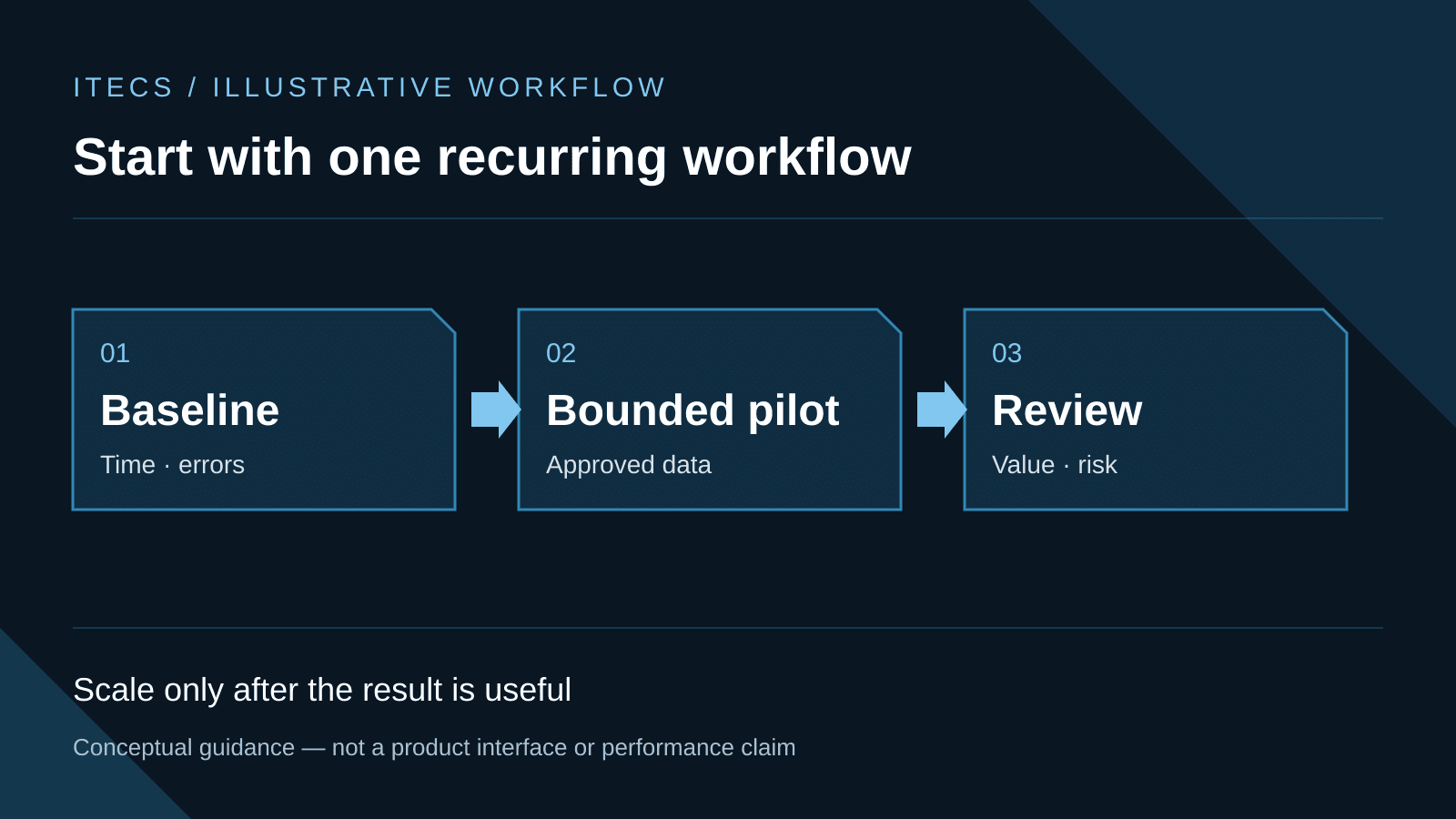
The first step is selecting one recurring workflow and establishing a baseline. An experienced AI consulting partner can help identify the work, risks, owner, acceptance criteria, and measurement plan before tools or licenses are purchased.
Identify Your Biggest Time Drains First
Good candidates include repetitive data entry, customer follow-up drafts, report preparation, appointment intake, and recurring internal questions. AI may help, but deterministic automation or a process change may be safer and cheaper. Measure the current time, error rate, queue delay, and exceptions before choosing the solution.
List recurring tasks, rank them by business impact and risk, and select one bounded candidate. Document which data it uses, who approves the output, how the team works when the tool is unavailable, and what result would justify expansion.
Choose the Right AI Tools for Your Size
Not every AI tool fits every business. Here is how the landscape breaks down for companies with 10–300 employees:
Microsoft 365 Copilot may fit teams already governed through Microsoft 365. Verify current licensing, tenant controls, connectors, and data boundaries before enabling it broadly.
ChatGPT Business or Enterprise can support general knowledge work in a managed workspace. OpenAI says business data is not used for model training by default, but retention, sharing, connectors, identity, and eligible compliance features still need configuration and review.
Zapier and Make.com connect existing tools into automated workflows. Before granting write access, verify authentication, field mappings, duplicate handling, retries, logging, and a manual recovery path. Check current vendor pricing rather than relying on an article snapshot.
Custom AI solutions — like a custom AI agent connected to your business data, an AI receptionist that answers your phones 24/7, or AI-powered CRM automation — require a managed AI partner like ITECS to build and maintain. Scoped builds are quoted after the workflow, data, and integration requirements are clear; flat-fee ranges for every service line are published on our pricing page.
Start Small, Measure Everything, Then Scale
Organizations should pick one high-impact workflow, measure the before-and-after, and expand only if the evidence supports it. An AI consultant can estimate effort after reviewing data quality, integrations, approvals, and acceptance tests. Our CEO guide to AI ROI explains the measurement model.
For example, a home-services team could pilot faster routing of inbound web leads. The success measure would be observed response time, qualified-contact rate, conversion, opt-out rate, and sales-team exceptions compared with the pre-pilot baseline—not an assumed percentage lift.
Protect Your Data from Day One
For Dallas businesses in healthcare, legal, or financial services, data safety is not optional. Public AI tools like the free version of ChatGPT should never be used for sensitive client data. Your employees are likely already pasting customer emails, financial reports, and internal documents into public AI tools — creating compliance risks you might not discover until an audit.
The response is an approved environment and enforceable data policy, supported by identity, least privilege, retention controls, DLP, logging, and training. ITECS builds governed custom AI agents, but no control guarantees that leakage can never occur. Regulated and privileged data requires plan-, contract-, feature-, and workflow-specific review.
Train Your Team to Use AI Safely and Effectively
Buying AI tools without training is like buying a truck fleet and handing employees the keys without a driving test. Your team needs to know what AI can and cannot do, which data is safe to share, how to write effective prompts, and when to trust (or override) AI output.
ITECS runs hands-on AI training workshops for non-technical staff — sales reps, customer support agents, HR managers, accountants, and office admins. Workshops cover prompt engineering for business tasks, data safety rules for your specific industry, and practical exercises using the AI tools you've already deployed. Most teams go from skeptical to productive within a single half-day session.