01
Governance
Teams adopt tools faster than leadership can set policies.
ITECS defines approved use cases, data rules, human review paths, and operating ownership before AI spreads.
AI Receptionist
ITECS deploys AI voice agents that can answer calls around the clock, book appointments, and route exceptions securely. Capacity, availability, and savings targets are confirmed during discovery.
Your phones ring after hours, during lunch, and when your team is busy. ITECS can deploy a voice agent that answers the business line, books appointments into an approved calendar, qualifies leads using defined criteria, and routes or records exceptions for a human team member.
The Stakes
Most organizations do not need another disconnected AI experiment. They need a managed operating model that tells people what is approved, where data can go, which workflows deserve investment, and who owns reliability after launch.
ITECS Position
Managed Intelligence applies ITECS's 24-year managed IT and cybersecurity operating model to AI systems, prompts, agents, connectors, and employee adoption.
Teams adopt tools faster than leadership can set policies.
ITECS defines approved use cases, data rules, human review paths, and operating ownership before AI spreads.
Sensitive data moves into public prompts, unmanaged plugins, and disconnected workspaces.
ITECS brings managed-IT discipline to access, identity, data handling, and vendor selection.
AI experiments consume subscriptions and meetings without a measurable operating case.
ITECS starts with workflows, cost of delay, and measurable outcomes before recommending build work.
Useful pilots stall when they have to connect with Microsoft 365, CRM, service, or finance systems.
ITECS designs automation around the systems, permissions, approvals, and support model already in place.
Illustrative Planning Signal
Your receptionist handles walk-ins, transfers, and paperwork at the same time. When two calls come in at once, one goes to voicemail. That caller hangs up and calls your competitor. For businesses with 10-50 employees, this happens 5-15 times per week.
After-hours calls are worse. A potential $5,000 project calls at 6:15 PM and hears a generic voicemail greeting. They move on. You never know they called.
Illustrative Planning Scenario
This modeled example shows how an engagement could be scoped; it is not presented as a reported client result.
A 12-person dental clinic in Plano: could miss appointment requests during lunch and after hours while front-desk staff balance check-ins, insurance work, and calls.
Modeled outcome: A voice agent could answer approved questions, offer available appointment slots, and route clinical or sensitive exceptions to staff. Booking and revenue impact would be measured after launch.
Capabilities
We audit your incoming calls — what callers ask, which calls need a human, and which can be fully automated. We build a conversation script that sounds natural and matches your brand voice.
We configure a human-sounding AI voice agent on your existing business number. The agent connects to your calendar for real-time appointment booking, your CRM for lead capture, and your team's phones for live transfers when needed.
We review call transcripts, track booking rates and caller satisfaction, and refine the AI's responses weekly. You get a monthly report showing calls handled, appointments booked, and estimated cost savings.
How Calls Flow
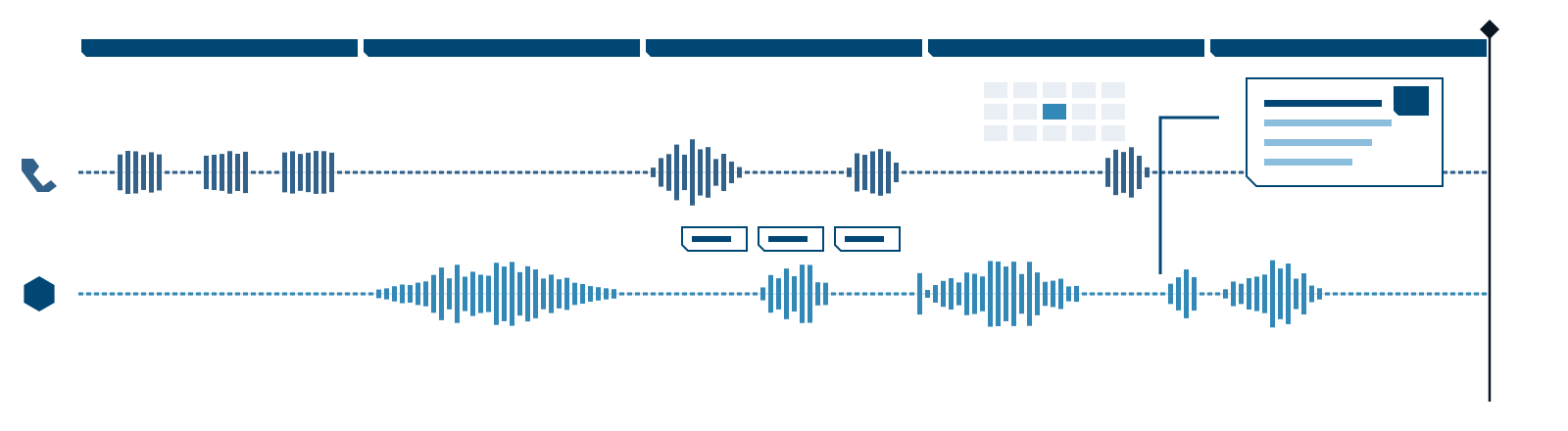
Call Comes In
Within the configured coverage window
AI Answers
Human-sounding voice agent
Handles Request
FAQs, routing, qualification
Books or Routes
Calendar booking or live transfer
Lead Captured
CRM updated automatically
Security
Call recordings, transcripts, and caller data follow the storage, access, disclosure, and retention controls selected for the telephony and AI vendors. ITECS AI is backed by ITECS, a Dallas cybersecurity MSP operating since 2002.
Pricing
The business case depends on current call volume, coverage, telephony, integrations, review requirements, and production operations. ITECS validates each comparison during discovery.
Planning comparison only. Scope, timing, and outcomes vary by data, workflow, approvals, adoption, and implementation conditions.
Outcome hypothesis to validate
ITECS compares current call-handling costs and missed-call volume with the proposed platform, usage, and operations costs before setting a savings target.
This is not a reported client result or guarantee. Baseline the current workflow and measure accepted work before relying on it.
Engagement Targets
Illustrative targets to baseline and validate during discovery — not reported client results or performance guarantees.
FAQ
A production voice workflow starts with Agent Discovery & Technical Specification at $4,500–$7,500, credited toward the build. A Single-Workflow Production Agent is $18,000–$35,000 after discovery confirms scope. Production operation is separate; one production agent is $2,500/mo.
ITECS can configure a natural-sounding synthesized voice and tune tone, pacing, and speaking style to the approved brand experience. The call flow should disclose automation where law, policy, or client preference requires it.
Yes. The AI connects to Google Calendar, Microsoft Outlook, or Calendly via API and books appointments in real time based on your availability rules. It handles time zone conversions, double-booking prevention, and sends confirmation texts/emails to callers automatically.
The approved exception path can transfer the caller to a live team member with context or collect a message for delivery through an agreed channel. Exact behavior depends on staff availability, telephony configuration, and the escalation rules tested before launch.