
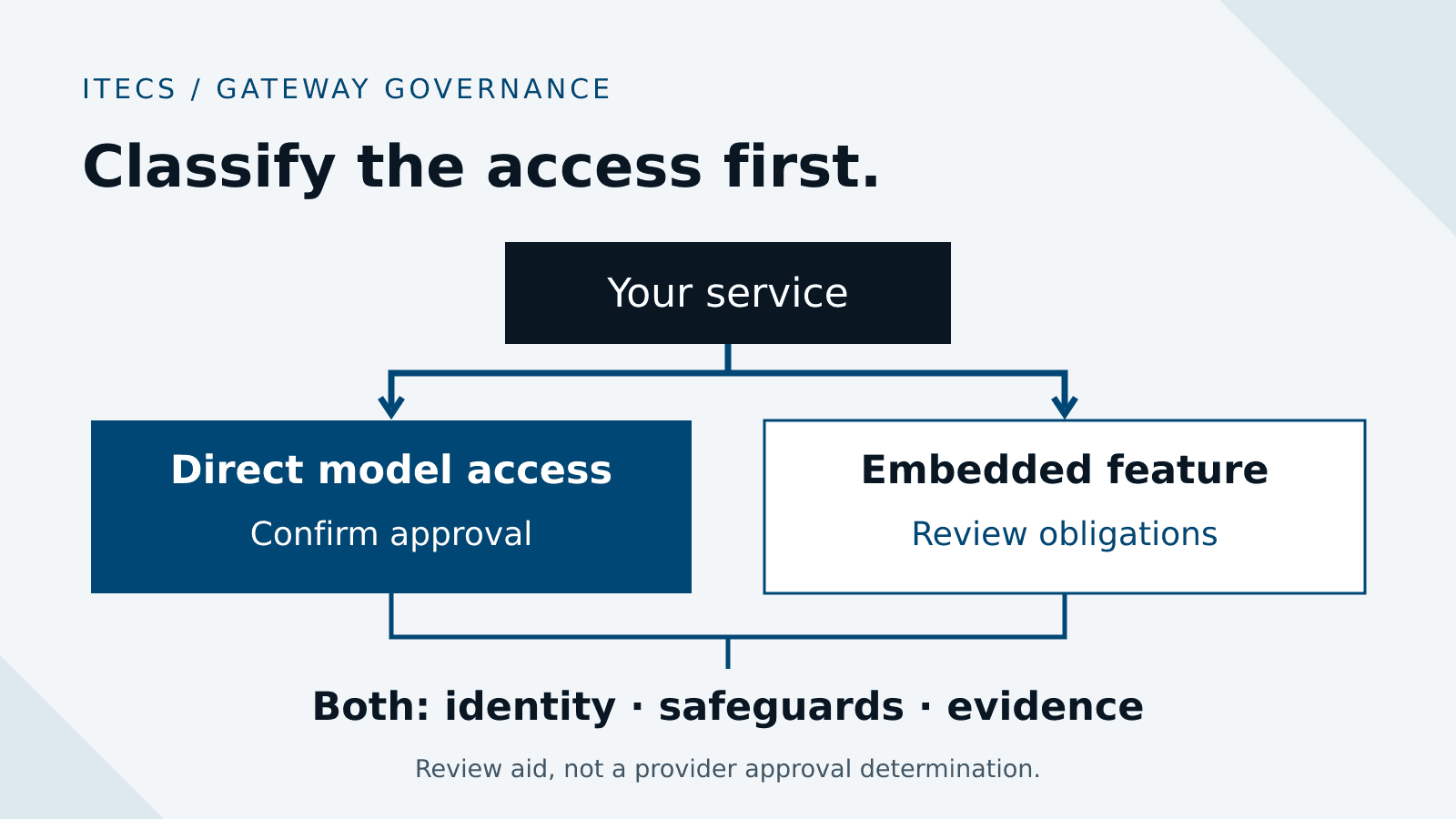
If your business gives customers access to OpenAI models through a router, gateway or reseller platform, start by checking what you actually provide, not what the product is called. OpenAI's updated Usage Policies, effective November 20, 2026, require prior review and approval for services enabling third parties to access its models directly. An application is not subject to that requirement solely because it uses OpenAI to power a feature.
That distinction should drive the work. A team selling model access has a different approval question from a team using a model inside a bounded invoice-processing feature. Both still need access controls, misuse handling and accountable ownership. This guide separates the published requirement from ITECS's recommended implementation plan. It is operational guidance, not legal advice or a claim of provider approval.
Classify the service before choosing a control
Ask the product owner to demonstrate the customer experience and the corresponding request path. Can a customer submit general-purpose requests to a model through your endpoint? Select models or use your service as a substitute access layer? Or are requests constrained to a defined product function? These are useful review questions, not a replacement for the provider's determination.
Document who supplies credentials, who contracts for the access, who controls the end-user relationship and which organization can suspend it. Do not assume that bring-your-own-key access, partner hosting or the word ‘embedded’ settles the classification. An internal gateway also needs a clear account of who uses it, including contractors or external customers; do not equate every internal proxy with a third-party intermediary.
For an uncertain case, give the OpenAI account or support contact, the contracted hosting partner and your legal owner the same factual architecture description. Ask for the applicable review route and retain the answer. The policy page does not establish a review turnaround or a universal application procedure. Working API access and a submitted review request are not evidence of approval.
Build an inventory that includes the routes people forget
Create one row per access path, not merely one row per application. Record the business owner, customer-facing function, tenant population, direct or partner provider, endpoint and model, upstream account or project, credential owner, contract reference, approval status, policy version and evidence location. Record identifiers and references, not key values.
Include fallback routes, batch jobs, developer consoles, image and voice endpoints, customer SDKs and legacy endpoints that remain reachable. Compare the inventory with gateway configuration, secret-manager references and redacted traffic metadata. A diagram of the intended architecture is not evidence that an old endpoint has stopped serving requests.
For partner-hosted access, establish which agreement governs the path and which party must seek or evidence approval. Obtain written confirmation of the actual scope rather than assuming a partner badge covers every downstream service. Keep pending, approved, not applicable with rationale, and unresolved classifications distinct. Set a review trigger for a new customer access mode, provider, model family or contract change.
Assign shared safety responsibilities without leaving gaps
Use a responsibility register that names an accountable person for each control. The platform owner maintains identity binding, routing and tenant isolation. Security owns credential exposure and containment. Trust and safety or a designated operations lead reviews suspected misuse and appeals. Customer administrators own their authorized users and use-case restrictions. Legal and procurement own contract interpretation and approval evidence. Provider responsibilities must come from the applicable agreement, not your assumptions.
Turn the agreed safeguards into versioned gateway configuration. New tenants should inherit the baseline; exceptions should identify an approver, reason, expiry and compensating controls. Test that a tenant cannot weaken another tenant's settings or bypass controls through a secondary endpoint. Content screening is only one layer: authentication, authorization, rate limits and tool permissions solve different problems.
A proposed request flow is: authenticated user → tenant and use-case authorization → applicable safeguards and safety identifier → approved upstream route → response checks → restricted evidence record. This is a design pattern, not a claim that a particular gateway already implements it. Do not configure failover to evade a provider's safety refusal or suspension.
Use SafetyIDs without turning logs into an identity database
OpenAI's safety guidance recommends safety identifiers for products with individual end users; it does not make them universally mandatory. The safety_identifier request field associates activity with a stable user identifier. Realtime has a separate OpenAI-Safety-Identifier header flow. Verify the documentation for each endpoint and session rather than assuming one SDK setting covers every path.
Our recommended implementation is a server-issued opaque identifier, or a keyed hash derived from tenant and internal user identity. Keep it stable within the relevant upstream organization and bind it to the authenticated principal. Do not accept an arbitrary client-supplied value. Keep any identity mapping separately access-controlled and avoid sending names, email addresses or IP addresses as the identifier. Pseudonymization is not a guarantee of anonymity.
Use synthetic accounts to prove that one user stays consistent, different users do not collide, tenants cannot impersonate each other and the identifier reaches the upstream request rather than stopping at the router. Test each supported endpoint separately. Define offboarding and retention behavior, and do not rotate identifiers to evade enforcement. A SafetyID is an abuse-handling aid, not authorization to access a customer's documents.
Protect keys and collect evidence proportionately
OpenAI's production guidance recommends secure key storage, rotation and separation of staging from production. For a gateway, document which service can retrieve each key, what it can access and who can revoke it. Keep provider credentials out of browsers, client exports, support tickets and ordinary request logs. A shared upstream key must not become the only boundary between tenants.
Retain enough evidence to investigate a decision: UTC timestamp, internal request reference, provider request reference where available, pseudonymous tenant/user identity, route, control version, decision category and reviewer action. Restrict the mapping to real identities. Avoid retaining full prompts and outputs by default; where necessary and authorized, isolate sensitive evidence with a defined retention period, access log and deletion process. Legal holds need an explicit owner.
Alert on repeated blocked attempts, unexpected request volumes, revoked identities still reaching an upstream service and changes to enforcement configuration. Measure what the detector misses as well as what it blocks. A model refusal is not, by itself, proof of user misconduct, and a classifier's confident label is not a completed investigation.
Investigate first, contain according to risk
An incident workflow should preserve authorized evidence, distinguish observed behavior from hypotheses, identify the affected tenant and stop the relevant access path when needed. Escalate urgent exposure promptly. For less clear cases, use time-bounded restrictions and human review rather than treating every signal as grounds to disable an entire customer organization. Honor provider enforcement and applicable obligations throughout.
Record the reason, scope, duration and owner of an enforcement action. Provide a review or appeal channel where appropriate, and test that reinstatement requires an authorized decision. If a key is compromised, revoke it and verify replacement access through the controlled recovery path. Do not let a queued job, cached session or alternate route silently restore the prohibited access. Our agent incident-reporting playbook explains how to organize the evidence and escalation record.
Consider an illustrative reseller gateway with two tenants. A synthetic test account in Tenant A repeatedly attempts a prohibited action while Tenant B submits an allowed business task. The exercise should show that the relevant A identity can be contained across its routes, B remains isolated and usable, and a reviewer can explain the decision without receiving either tenant's private document contents. Add a harmless but ambiguous case to test whether the team can correct an unjustified block. This is a proposed exercise, not a reported client result.
A 30-day remediation plan with named owners
For a team starting on this article's publication date, October 22 through November 20 is a 30-calendar-day work window. Start provider engagement immediately and make the availability decision before November 20. The schedule below is an ITECS planning recommendation, not a provider grace period or approval-service commitment. If approval is required but unresolved, establish the restriction or suspension plan with the accountable owner instead of assuming continued operation is permitted.
Days 1–5 · October 22–26
Owner: Product, legal and procurement
Classify the service, inventory every direct and partner-hosted path, and send any required review request immediately. Keep unanswered classification and approval questions on a named-owner register.
Days 6–12 · October 27–November 2
Owner: Platform engineering and security
Implement tenant-bound authorization, server-owned safety identifiers, key isolation, policy propagation and restricted evidence capture. Test secondary routes as well as the default route.
Days 13–20 · November 3–10
Owner: QA, trust and safety, and customer operations
Run synthetic allowed and denied cases, tenant-isolation checks, identifier-forwarding checks and an incident exercise. Review false positives with a human, not only another classifier.
Days 21–29 · November 11–19
Owner: Accountable executive and release owner
Close required approval evidence, rehearse restriction and recovery, and review open exceptions. Decide before the effective date which routes can remain available; a pending request is not approval.
Day 30 · November 20
Owner: Service owner and on-call team
Verify the deployed route map, approval scope and control versions against the release record. Monitor exceptions and enforce the documented availability decision. This date is not an extension or a promised provider response time.
Define acceptance before running the tests
Use isolated tenants, synthetic identities and a controlled upstream test harness for denied-path and abuse scenarios. Validate provider-facing behavior only within authorized testing terms. Do not probe a live provider with harmful requests just to fill a checklist. Separate evidence that your gateway blocked a request from evidence that the upstream provider received a permitted one.
- Route coverage
- Inventoried production access paths / discovered production paths.
- Require 100% within the declared perimeter, including failover and partner routes. Reconcile configuration with sampled traffic; an incomplete discovery process cannot prove complete coverage.
- Required approvals
- Routes covered by confirmed applicable approval / routes requiring approval.
- Require complete written coverage before those routes operate under the new requirement. Report pending and unclassified routes separately; do not count either as approved.
- Identity and control coverage
- Eligible requests carrying the correct tenant/user identifier and approved control version / eligible requests tested.
- Require all supported paths to pass synthetic forwarding tests with no personal fields or cross-tenant identity substitution. Record unsupported endpoints explicitly.
- Detection and false positives
- Known prohibited cases detected / prohibited cases tested; allowed cases incorrectly blocked / allowed cases tested.
- Publish both counts and rates by abuse category, tenant and modality. Set risk-based targets before testing, adjudicate disagreements, and repeat stochastic cases.
- Containment and response
- Unauthorized actions in denied-path tests; time to detect, acknowledge and contain each exercise.
- Require zero unauthorized actions in the test set. Agree response deadlines with the incident owner and verify revocation across every route; passing tests is not proof of zero future risk.
- Evidence and recovery
- Investigations with complete authorized evidence / sampled investigations; successful rollback exercises / attempted exercises.
- Require a reproducible decision trail and tested recovery that retains safeguards. Track reviewer minutes, unresolved appeals and exception age as operational capacity measures.
Freeze the test cases and configuration version, retain results by route, and repeat the checks after gateway, SDK or model changes. A rollback must restore a known configuration without reopening a prohibited route. Keep failures in a permanent AI regression test set, and have someone other than the implementer review the closure evidence for high-risk gaps.
Make the release decision inspectable
A useful readiness pack contains the service classification, complete route inventory, applicable approval records, responsibility register, control versions, test results, open exceptions and incident/recovery runbook. Its purpose is to let an accountable leader see what is known, what is unapproved and what the team will do if access must be restricted.
Sources were checked October 22, 2026. Recheck the live policy and endpoint guidance before the effective date and whenever your access model changes. Technical controls do not substitute for required provider approval, and approval does not certify compliance with every law or customer contract.
ITECS can help turn that readiness pack into a bounded AI consulting engagement: map access paths, assign control owners, test tenant boundaries and prepare an evidence-based release decision. For ongoing ownership, discuss the operating responsibilities of a managed intelligence provider, not just the gateway software.
