
An invoice changes its layout, a purchase order adds a column, or a scanned claim arrives with a handwritten correction. AI can help extract the information, but a system that learns from every correction can also learn the wrong rule. The practical answer is to let the workflow propose improvements while people control which instructions reach production.
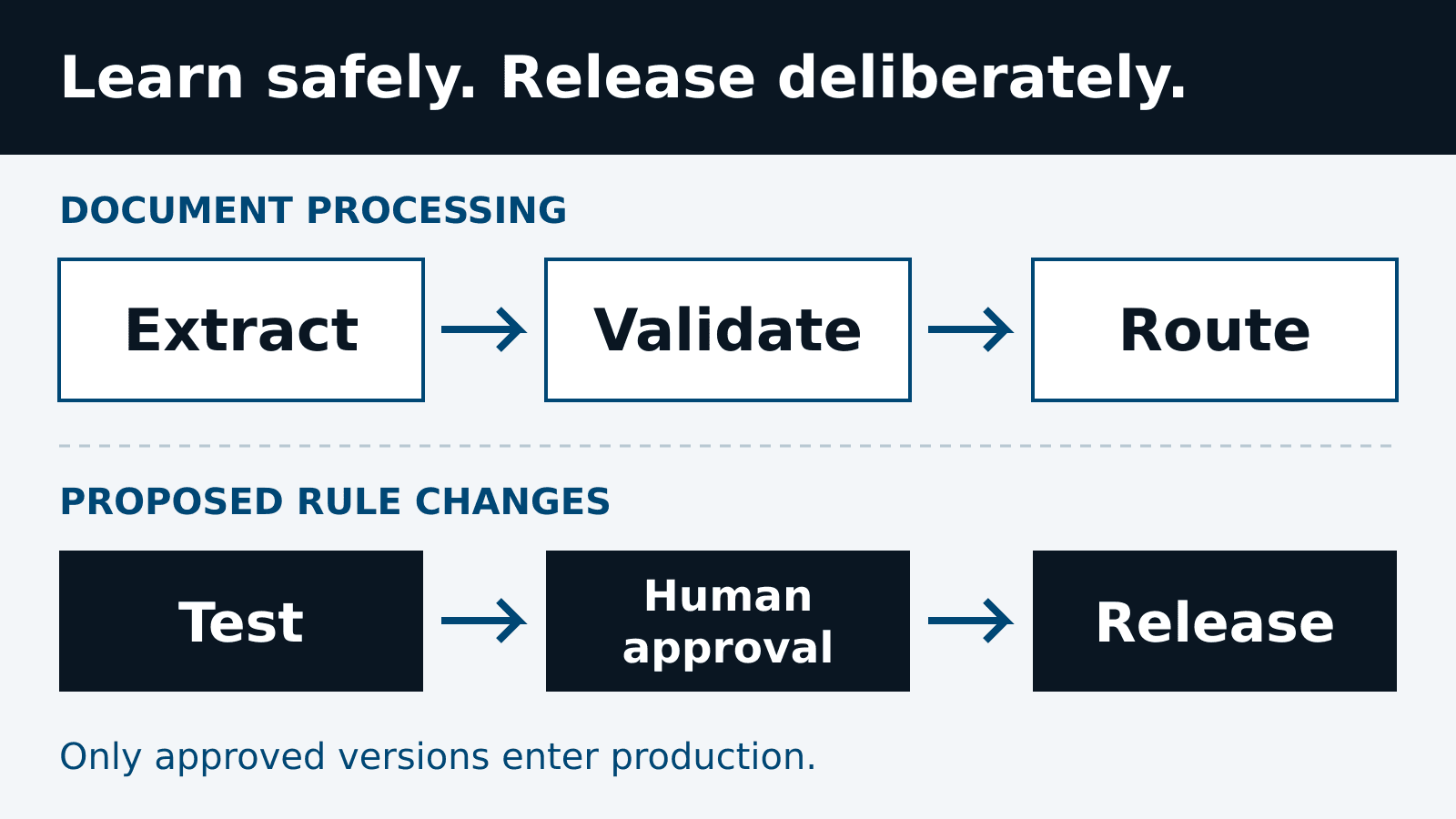
Pilot AI document processing as two connected processes: a stable processing lane that classifies, extracts, validates and routes documents, and a controlled change lane that tests proposed instructions before an accountable reviewer approves them. Start with one document family and one downstream decision. Do not give an extraction model permission to rewrite its own business rules or approve payments.
What self-improving document processing actually means
Learning may mean changing an extraction instruction, adding labeled examples, retraining a model or selecting a different processor version. These are different changes with different risks. Ask the provider exactly what changes, where it is stored, who can publish it and whether existing requests immediately use it.
For example, Amazon Bedrock Data Automation blueprint optimization compares examples with ground-truth values and refines field instructions without model training or fine-tuning. Its documentation describes saving the optimized blueprint for subsequent inference. That is an instruction-change mechanism, not evidence that every correction should automatically become an operating rule.
Our recommendation is to treat optimized instructions as a candidate release. An improvement on the examples used for optimization does not establish performance on unseen layouts. Keep independent evaluation documents that the optimizer and instruction author have not used.
Classify the document before extracting its fields
Define the accepted population: for example, domestic supplier invoices for a single business unit, excluding statements, credit notes and attachments without an invoice. Record file types, languages, page limits, scanning quality and expected volume. Route unsupported or uncertain documents to an exception queue instead of silently forcing them into the closest category.
For mixed PDFs, test document boundaries as well as classification. A bundle containing an invoice, a purchase order and delivery evidence must not become one merged record. Preserve page order, source identifiers and the relationship between each extracted field and its source page. Quarantine unreadable, encrypted or incomplete inputs with an explicit reason.
Create a versioned schema for each class. Define field names, types, required versus optional values, units, currencies, date conventions and line-item structure. Distinguish missing, illegible, contradictory and not applicable. Keep both the original extracted value and any normalized value with provenance; never invent a missing amount to satisfy a required field.
Build a test set that includes the awkward documents
Have domain reviewers establish correct labels and adjudicate disagreements. Include digital PDFs and scans, skew, low contrast, handwriting, multi-page tables, split rows, duplicate files, credit amounts, currency differences, ambiguous dates, missing totals and documents from previously unseen suppliers. Add documents containing misleading instructions to verify that document text remains data rather than authority.
Separate tuning, validation and final holdout sets by supplier or layout family where possible. Randomly splitting near-identical invoices can make generalization look better than it is. Keep an unseen-layout cohort and report it separately. Include no-match and multiple-match cases, not only records with a convenient answer in the system of record.
Choose sample sizes with the owner of the downstream risk. A handful of clean examples is useful for a demonstration, not a reliable estimate of rare payment or claim errors. Report the document count, field count, layout mix and uncertainty alongside every accuracy percentage.
Validate against records the business already trusts
Extraction asks what the document says. Validation asks whether that information is acceptable for the intended operation. Keep this distinction explicit in code and ownership. Use typed, deterministic checks for required fields, arithmetic, date ranges, permitted currencies and duplicate identifiers before attempting a business match.
For an invoice pilot, read approved supplier and purchase-order records with a restricted identity. Check supplier identity, purchase-order status, line references, quantities, unit prices and agreed tolerances. Compare receipt evidence where the process requires it. For claims, use the approved claim and policy records relevant to the task. A plausible name or nearest text match is not enough to establish identity.
If the authoritative system is unavailable, stale or returns several candidates, mark validation incomplete and route the document for review. Do not let high extraction confidence override a failed business rule. Keep write-back, payment release and claim adjudication outside the initial extraction pilot. Use boundary testing to verify that blocked or impossible work stops rather than reaching for unapproved access.
Use confidence to route work, not to certify truth
Microsoft's Document Intelligence guidance distinguishes confidence at different levels and notes that not every field returns a score. It also warns that measured accuracy can differ on documents unlike the training set. Check the selected model and API's actual output rather than assuming every field has a comparable confidence value.
Calibrate routing thresholds against your labeled documents by field, class and consequence. A descriptive memo field and a bank-account field should not share one acceptance threshold. Missing confidence is not full confidence. Even a confident extraction must pass schema, identity and business-rule checks. Sample accepted documents for review so false accepts do not disappear from measurement.
Each exception needs a reason, severity, owner and due time. Show reviewers the source region, extracted value, failed checks and candidate matches. Record corrections separately from final approval. Monitor queue age and capacity; a growing queue can erase the benefit of faster extraction. Unresolved cases stay unresolved rather than being counted as completed work.
Version instructions and require approval before promotion
Package the classifier, extraction schema, instruction text, model or processor identifier, normalization logic, validation rules and routing thresholds as one traceable release. Attach the test-set version, evaluation results, change rationale, approver and effective time. Review the actual instruction diff: a new instruction that fixes one vendor must not quietly weaken a required field for every vendor.
Corrections enter a proposed-change queue. A domain reviewer confirms the label; an owner evaluates the candidate against the frozen baseline, edge cases and unseen layouts; a release approver accepts or rejects the change. Restrict publishing rights separately from labeling rights. For consequential workflows, the person proposing the rule should not be its sole approver.
Google Document AI's version guidance distinguishes default versions from explicitly selected versions and explains deprecation behavior. Record which version actually handled each request. Manage default changes deliberately, monitor retirement notices and evaluate a supported replacement before the old version becomes unavailable. A pinned identifier is not a promise of indefinite vendor support.
Example: a correction that must not become a global rule
Consider a hypothetical accounts-payable pilot. A supplier moves its purchase-order reference below the invoice number. Extraction chooses the invoice number as the PO reference. The value is legible and confidence is high, but the ERP lookup finds no matching order, so the document enters the exception queue.
A reviewer identifies the correct reference and proposes a more precise field instruction. The candidate passes that supplier's examples but fails a different layout whose footer contains an old order number. The team rejects promotion, adds the conflicting case to development tests and revises the instruction. It then evaluates a fresh holdout rather than repeatedly tuning against the same final test.
Only after the candidate passes the agreed checks does the approver publish a new version to a limited cohort. The original document, correction and release decision remain linked. If false matches rise, the operator pauses automation and restores the previous supported bundle. No model-generated match releases a payment.
Protect documents, corrections and logs as sensitive data
Before uploading samples, confirm approved regions, provider retention and training terms, encryption and access boundaries for the actual service and account. Use synthetic or appropriately minimized documents during setup. A development label set containing bank details, health information or employee records can be as sensitive as production data.
Separate intake, processing, outputs and review stores. Give each component only the access it needs, keep credentials out of prompts and prevent document content from selecting tools or network destinations. Do not log complete documents or extracted personal fields by default. Use opaque run identifiers and controlled evidence links; audit who opens the originals. See our scanned-document redaction guide when test material requires de-identification.
Define retention by artifact: originals, labels, extracted values, corrections, traces and backups. Preserve records required by the business and applicable obligations, but do not retain every sample forever just because it might improve a model. Assign deletion owners and verify expiry, including temporary uploads and exported evaluation datasets.
A staged pilot with an explicit stop path
Stage 1: run an offline evaluation on approved fixtures. Establish current manual accuracy, reviewer effort and cost, then compare the candidate on the same population. Require complete accounting for every input, including rejected files, failed extraction and timed-out jobs.
Stage 2: run in shadow mode against a bounded production sample with read-only system access. Review all proposed outcomes while existing operations remain authoritative. Compare classifications, field values and matches with actual decisions. Do not count a proposed match as a successful transaction.
Stage 3: allow a small, reversible internal handoff for the lowest-risk class after the business owner accepts the scorecard. Keep high-impact actions separately approved. Set volume, retry, concurrency and spending limits, a queue owner and a pause control. Expand only when the accepted cohort remains within its limits.
Rollback must restore the complete supported release bundle, not just a prompt. Test pausing intake, draining or quarantining in-flight work, restoring configuration and identifying records processed by the suspect version. Reprocessing must preserve record identity and avoid duplicate downstream writes. An older model that the provider has retired is not a usable rollback target; keep a manual path as well.
Acceptance measures that reveal the real tradeoff
Agree on thresholds before running the final evaluation. The scorecard below defines proposed measures, not universal targets or reported ITECS results. Use stricter criteria for consequential fields and report cohort sizes. A clean sample does not prove that future errors are impossible.
On a narrow screen, scroll horizontally to compare the measures.
| Measure | Definition | Acceptance consideration |
|---|---|---|
| Field accuracy | Correct required field values / all required field instances in the labeled cohort; missing values fail. | Report critical fields separately, with normalization rules fixed before scoring. |
| Validation failures | Documents failing each deterministic check / all eligible documents received; also report checks that could not run. | Distinguish bad inputs from extraction defects and unavailable reference systems. |
| Straight-through processing | Eligible documents completed without review and with all required checks passed / all eligible documents received. | Include failed jobs; separately track later-discovered errors and excluded classes. |
| Reviewer time | Median and p95 active review minutes per exception, plus total human minutes / eligible documents received. | Compare with the manual baseline and track queue age, not just screen time. |
| False matches | Incorrect accepted record matches / all accepted matches in the adjudicated sample. | Report the sample size, no-match cases and severity; stop on consequential false matches. |
| Cost per document | Extraction, OCR, optimization, retries, storage and review costs / eligible documents received. | Also show cost per correctly completed document so failures cannot make the workflow look cheap. |
| Unseen layouts | Field accuracy, false matches and completion rate on supplier/layout families excluded from tuning. | Compare separately with familiar layouts; do not hide a weak cohort in the overall average. |
| Completeness and latency | Reconcile every input to a terminal status; measure p50/p95 arrival-to-disposition time. | No silently skipped records. Report failures, unreadable files and unresolved exceptions. |
Treat any observed unauthorized disclosure, unapproved rule promotion or consequential false match as a pilot stop condition. Set numerical accuracy floors, queue-age limits, reviewer-time targets and cost ceilings with the process owner before testing. Do not improve straight-through processing by dropping difficult documents from its denominator or weakening validation.
Monitor releases, not just successful API calls
Record document class, processing status, model and instruction versions, validation outcomes, confidence where available, reviewer disposition, retry count, latency and cost. Track shifts by supplier, layout and scan quality. Alert on rising unknown classes, missing required fields, false matches, exception age and sudden changes in straight-through rate.
Reevaluate when a provider model, instruction, schema, business rule or document population changes. Compare candidate and baseline on the same protected test set, then inspect new failures before promotion. Keep incident evidence and a clear owner for correction, communication and recovery. The objective is dependable processing with controlled improvement, not the largest possible volume without review.
If your team is considering workflow automation, start by mapping one document family to its authoritative records and exception owner. Talk with ITECS about a bounded pilot that connects extraction, validation, review and release controls before broader use.