Updated August 31, 2026: This guide removes adoption forecasts and universal compatibility claims. MCP is an increasingly adopted open protocol, but each client, server, transport, tool, schema, permission, and security boundary must be verified.
The Model Context Protocol defines a client-host-server architecture for exposing tools, resources, and prompts to AI applications. Linux Foundation governance and adoption by major platforms make it relevant to business architecture, but they do not guarantee that a connector is trustworthy, compatible, or appropriate for sensitive data.
The short version for business leaders: MCP can reduce bespoke integration work, but it does not make tool access secure by default. A governed program needs an approved registry, scoped identities, schema and metadata review, invocation logs, change control, human approval for high-impact actions, and a rapid revocation path.
What MCP Actually Is, In Plain English
Until MCP, every AI assistant needed a custom integration to talk to every business tool. Connecting ChatGPT to your HubSpot CRM required one piece of code. Connecting it to your QuickBooks ledger required another. Connecting Claude to the same systems required a third and a fourth. Multiply that across 30 SaaS tools, three AI vendors, and a moving target of model versions, and the integration bill grew faster than the AI savings.
MCP provides a common interface that can reduce some client-to-tool integration work. Implementations still vary in supported protocol versions, transports, authentication, schemas, extensions, reliability, and side effects. Adapters, testing, upgrades, and provider-specific code may still be required.
MCP therefore belongs alongside APIs and identity systems in the architecture. It can standardize discovery and invocation without eliminating contracts, vendor dependencies, access design, or change management.
Why Anthropic Donated It, And Why That Matters
Anthropic created MCP in November 2024. In twelve months, it became one of the fastest-growing open-source projects in AI history. By donating it to the Linux Foundation's new Agentic AI Foundation, Anthropic took the protocol off its own balance sheet and placed it under neutral, vendor-independent governance.
The Agentic AI Foundation was co-founded by Anthropic, Block, and OpenAI, with founding support from Google, Microsoft, AWS, Cloudflare, and Bloomberg. Block donated its Goose agent runtime. OpenAI donated the AGENTS.md specification. UiPath has since joined as a Gold Member.
Neutral governance can reduce dependence on one vendor's specification, but it does not remove concentration or exit risk. Hosts, servers, models, authentication, hosting, and commercial terms may remain provider-specific. Preserve an inventory, exportable configuration, evaluated alternatives, and a manual operating path.
Adoption Is Growing, but Coverage Must Be Verified
Major AI and software vendors have announced or documented MCP support, and connector catalogs are expanding. Do not infer support from a brand name or third-party listing. Verify the publisher, exact server, version, authentication, data access, side effects, hosting model, maintenance status, and review date.
The operational question is whether the organization has a controlled way to approve, test, monitor, update, and revoke agent tool connections—not whether every application will adopt one protocol on a predicted schedule.
A Specific Scenario For Dallas Businesses
Consider a 60-person Dallas insurance brokerage. The leadership team has approved Microsoft Copilot for licensed agents, a private custom AI assistant for claims research, and a third-party AI receptionist that handles overflow calls. Each tool wants access to the agency management system, the document repository, the CRM, and the underwriting database.
Without MCP, that is twelve custom integrations the IT team has to build, maintain, and secure. With MCP, each business system exposes one server, and each AI tool consumes the same standard. But now a new problem appears: who controls which AI can read what? Who logs the calls? Who revokes access when an employee leaves? Who tests upgrades when a vendor pushes a breaking change to a server schema?
That governance gap is where most 2026 AI projects will succeed or stall.
The Sprawl Problem MCP Creates
MCP can make some connections easier to configure. It does not make implementation or management trivial.
As approved tools grow, the same questions recur: Which servers run on which hosts? Who owns and patches them? Are calls audited? Is sensitive data minimized? Are credentials rotated? Did a publisher change the description or schema, and was the change reviewed?
This is exactly the problem managed services were invented to solve. In the 1990s, businesses standardized on TCP/IP, then discovered they needed managed network providers to actually run the network. In the 2000s, businesses standardized on email and SaaS, then discovered they needed managed IT and security providers to actually govern access. In 2026, businesses are standardizing on MCP, and they will need a Managed Intelligence Provider to actually run the agent fabric.
Where The Managed MCP Gateway Comes In
A managed MCP gateway is the control plane that sits between your AI tools and your business systems. Industry analysts including Gartner now describe MCP and A2A as the foundational protocols of the agentic era, equivalent to the role TCP/IP played for the early commercial internet. That comparison is useful because TCP/IP did not eliminate the need for routers, firewalls, and managed networks — it required them.
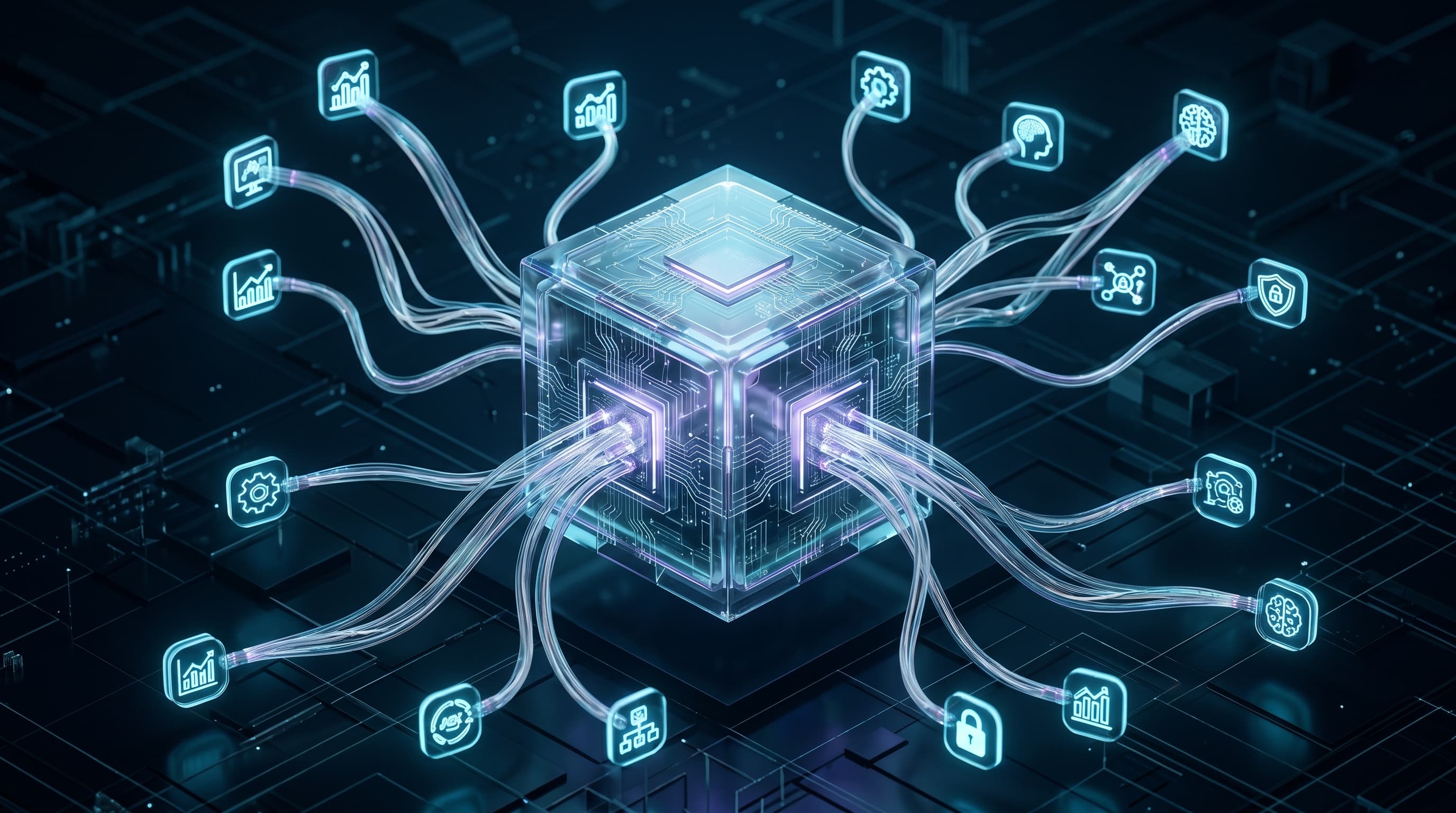
In a managed MCP architecture, your AI clients do not talk directly to every SaaS or internal database. They talk to a gateway that enforces policy, logs every call, applies data loss prevention, brokers credentials, and unifies observability. The gateway is the place where an MSP-style provider adds the most value: keeping connectors current, enforcing security policy, and giving leadership a single dashboard of what every AI agent has done across the business.
MCP And A2A: The Two Protocols Powering Agentic AI
MCP handles agent-to-tool communication. A2A — Agent-to-Agent, originally proposed by Google and now also under the Agentic AI Foundation — handles agent-to-agent communication. Together, they form the foundation of multi-agent business systems.
In practical terms, an MCP-enabled agent can read a customer record from your CRM, summarize the case, and draft a response. An A2A-enabled set of agents can hand work between specialists — a research agent, a compliance reviewer, a billing agent, and a human approver — without custom glue code. Most Dallas businesses will adopt MCP-only workflows first, and A2A workflows second as their AI maturity grows.
MCP and agent-to-agent protocols may support more portable workflows, but interoperability and governance are properties to test. Protocol conformance alone does not establish permission, accountability, semantic compatibility, or safe delegation.
Security Implications Business Leaders Should Understand
MCP is a transport. It is not, by itself, a security model. Every MCP server runs with the credentials it is given. Every MCP client trusts the responses it receives. Without governance, MCP can enlarge your attack surface as fast as it enlarges your AI capability.
This is where the security discipline of a managed AI partner becomes the difference between an AI program and an AI incident. The NIST AI Risk Management Framework provides the policy backbone. The implementation work — credential brokering, audit logging, PII redaction, server allowlisting, schema validation, and version pinning — is the day-to-day job of the MCP gateway and the team that runs it.
At ITECS, MCP governance sits on top of the same security operations practice that has supported Dallas businesses since 2002. We treat AI agents the way we treat privileged users: documented, audited, scoped, and continuously reviewed.
What Business Leaders Should Do In 2026
You do not need to know how MCP works to make the right decisions about it. You need to know three things.
First, evaluate MCP where supported, but do not adopt it by default. Compare it with existing APIs and integration platforms for the specific workflow, then choose the smallest governed interface that meets the requirement.
Second, MCP without governance is shadow AI in a new uniform. Letting employees connect personal AI tools to business systems through unmanaged MCP servers carries the same compliance risk as letting them paste customer data into public ChatGPT.
Third, the highest-leverage AI investment for most growing teams this year is not a custom agent. It is a managed AI operating model: which tools are approved, which MCP servers are allowed, how the gateway is configured, who reviews the logs, and how employees are trained to work alongside it.
How ITECS Approaches Managed MCP
ITECS is a Managed Intelligence Provider — an MSP-grade approach applied to AI. For MCP specifically, that work breaks down into four practical steps.
We start with a discovery audit of every AI tool already in use across your business, including unsanctioned ones. We then design a managed MCP architecture that fits your existing stack — Microsoft 365, Google Workspace, HubSpot, Salesforce, QuickBooks, Slack, or whatever else runs your operation. We deploy a governed gateway with policy, logging, and observability. We train your team on what to use, what to avoid, and why.
For more complex environments, the same discipline carries into custom AI agents, secure private AI workspaces, and AI DevOps practices that turn AI work into a repeatable operating process rather than a permanent experiment. Smaller engagements look like consulting hours, structured workflow design, and employee AI training. Larger engagements look like a managed gateway, ongoing MCP server curation, and quarterly governance reviews. Both run on the same hourly or prepaid retainer model ITECS has used for traditional IT services for 24 years.
The Bottom Line
MCP's governance and growing ecosystem make it worth evaluating. The durable advantage comes from a governed, observable tool layer with clear ownership, evidence, and an exit path—not from protocol adoption alone.
That operating discipline is part of the managed AI work ITECS provides today.