
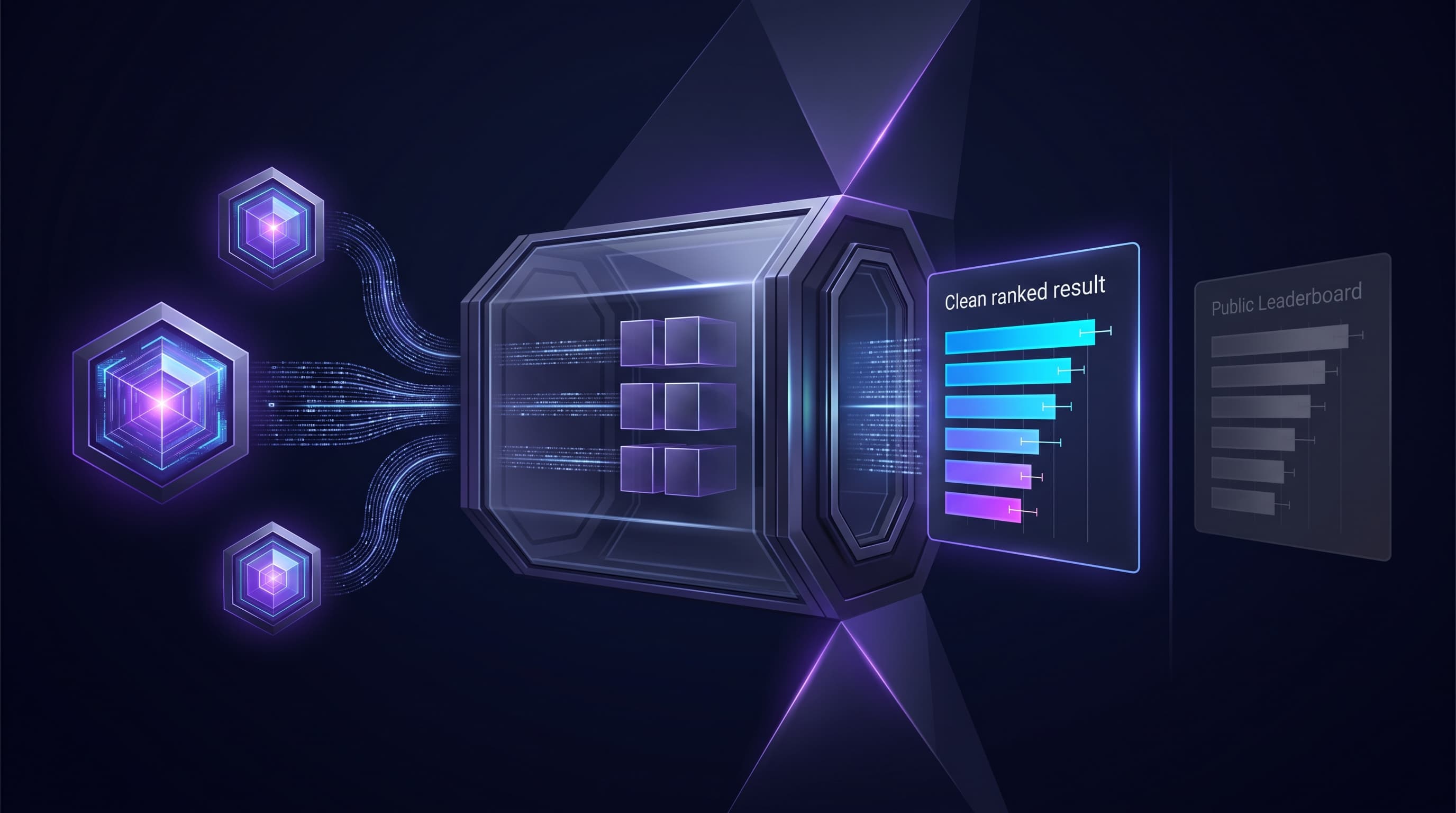
Every model vendor leads with a number. A leaderboard rank, a benchmark score, a percentage that says this model is the best. Executives buy on those numbers and deploy into customer service, security, finance, and operations — then wonder why the model that topped the chart underperforms on their actual work. The problem is not the model. It is the evaluation. A public leaderboard measures a public test, not your job. In July 2026, the U.S. government's own standards body made the point unmistakable by building a blind-data testbed to evaluate models the honest way. Here is how to do the same before you deploy, with the vendor-neutral evaluation discipline to back it.
Public AI leaderboards do not predict how a model performs on your work, and many benchmarks leak into training data, inflating scores. Before you deploy a model into customer, security, finance, or operational workflows, test it on task-specific blind data it has never seen, using your own domain datasets and common metrics. Separate vendor claims from your deployment decision, document the uncertainty, and keep monitoring after go-live — because one benchmark result is not a business guarantee.
The Leaderboard Is Not the Job
A leaderboard answers one question: how did this model score on a shared, public test. That is useful for researchers and nearly useless for a deployment decision. Your workflow is not the benchmark. A model that tops a general reasoning chart may badly misread your support tickets, your contracts, or your transaction patterns, because none of those were in the test it aced.
The gap widens with the stakes. A model picked for a customer-service workflow will meet phrasing, products, and edge cases no public benchmark contains. A security model will see your logs, not a tidy academic dataset. A finance model will read your ledgers and your fraud patterns. The only evaluation that predicts performance on your job is an evaluation built from your job — a principle we apply when we help clients pick the right model for security, where the benchmark rarely matches the real threat.
NIST Built a Blind Testbed for a Reason
The clearest endorsement of this approach came in July 2026 from the National Institute of Standards and Technology. NIST announced the Artificial Intelligence Technology Evaluation, or AITE, a voluntary program run by its Technology Test and Evaluation Division. In NIST's description, AITE gives models blind data to process inside a sequestered testbed, so evaluators gain objective insight into what a model can actually do.
The design choice that matters is why the data is blind. NIST states that the sequestered environment mitigates the risk of train/test data contamination — the exact failure that inflates public scores. The first evaluations, focused on image analysis with large vision language models across quantum science, genomics, and public safety, are set to begin in August 2026, with NIST planning to expand the program in four phases. Separately, NIST's Center for AI Standards and Innovation runs pre-deployment safety testing of frontier models. The throughline is unmistakable: the nation's measurement authority does not trust a public score, and neither should you.
| Practice | Why it matters | What to do |
|---|---|---|
| Task-specific blind data | Public scores do not predict your task | Test on held-out data the model never saw |
| Contamination checks | Models memorize benchmarks in training | Confirm the test set is not in training |
| Common metrics | Different scales cannot be compared | Score every model the same way |
| Your domain datasets | Generic tests miss your real inputs | Add data from your actual workflow |
| Claims vs approval | A vendor benchmark is marketing | Make deployment a separate decision |
| Documented uncertainty | One number hides the error bars | Record confidence and failure modes |
| Post-deployment monitoring | Models drift once real data arrives | Keep scoring the model after go-live |
Benchmark Contamination Is the Quiet Failure
Contamination is the problem most buyers never see. Modern models train on enormous slices of the internet, and popular benchmarks live on the internet. When a test set leaks into training data, the model has effectively seen the answers, and its score measures memorization, not capability. The result looks like brilliance and behaves like a student who got the exam in advance.
This is why NIST sequesters its data, and why your evaluation must use inputs the model could not have trained on. Hold out a fresh sample of your own data and never share it with the vendor. A support classifier that scores 95 percent on a public set but 70 percent on your held-out tickets just told you the public number was contaminated or irrelevant. NIST's announcement of the AITE program is explicit that guarding against train/test contamination is the point — treat that as your standard, not an academic nicety.
Separate Vendor Claims From Deployment Approval
A vendor's benchmark is a marketing asset, and there is nothing wrong with that — until it becomes your approval decision. The two must stay separate. A claim tells you what the vendor measured; approval is your judgment that the model is safe and effective for a specific workflow, on your data, at your risk tolerance. Collapsing the two is how contaminated scores end up in production.
Good evaluation also refuses false precision. One accuracy number hides the error bars, the failure modes, and the cases where the model is confidently wrong. Document the uncertainty: where the model struggled, how often, and how badly. Then make deployment a deliberate gate, not a default — the same posture we build into agentic AI infrastructure and every AI-enabled system we inventory.
- 01
Define
Write the task and the metric that means success for your workflow.
- 02
Blind-test
Score each model on held-out domain data it has never seen.
- 03
Compare
Rank models on common metrics, with uncertainty, not vendor claims.
- 04
Monitor
Keep evaluating after production, because data and models drift.
Your Model Evaluation Checklist
A trustworthy evaluation follows a short discipline. ITECS runs this before any model reaches a real workflow.
Test on task-specific blind data. Score every model on held-out data drawn from your actual workflow, which the model has never seen and the vendor never receives.
Watch for benchmark contamination. Assume popular benchmarks may have leaked into training. Use fresh, private data so the score reflects capability, not memorization.
Compare on common metrics. Score every candidate the same way, on the same data, so the comparison is real. Different scales and different tests cannot be ranked.
Include your domain datasets. Add examples from your customers, your logs, your ledgers, and your edge cases. Generic tests miss the inputs that actually break a model.
Separate vendor claims from approval. Treat a benchmark as a claim to verify, and make deployment a distinct, documented decision on your data and your risk.
Document the uncertainty. Record where the model failed, how often, and how confidently it was wrong. One accuracy number is not an evaluation.
Monitor after production. Keep scoring the model once real data arrives, because inputs shift, models update, and last quarter's result is not a guarantee.
How ITECS Evaluates Models Before You Deploy
Most companies evaluate a model by reading its marketing. ITECS evaluates it against your work. We are vendor-neutral: we do not sell a model, so we have no reason to flatter one. We define the task and the metric that means success for your workflow, build a blind test set from your own data, score every candidate the same way, and hand you a ranked result with the uncertainty attached — not a leaderboard screenshot. Then we stand up the monitoring that keeps the answer honest after go-live.
We price this the way we price all advisory work — hourly consulting or prepaid retainer hours with tracked usage, no monthly minimum and a 12-month expiry, plus a flat fee for a scoped model-evaluation build. We start with a data and AI readiness audit and pair the result with the guardrails to run a model safely, including an emergency stop for any agent that acts on your systems. The payoff is a deployment decision you can defend: the right model for the job, proven on your data. When you are ready to evaluate before you deploy, talk to the ITECS team.