Overlooked prerequisites
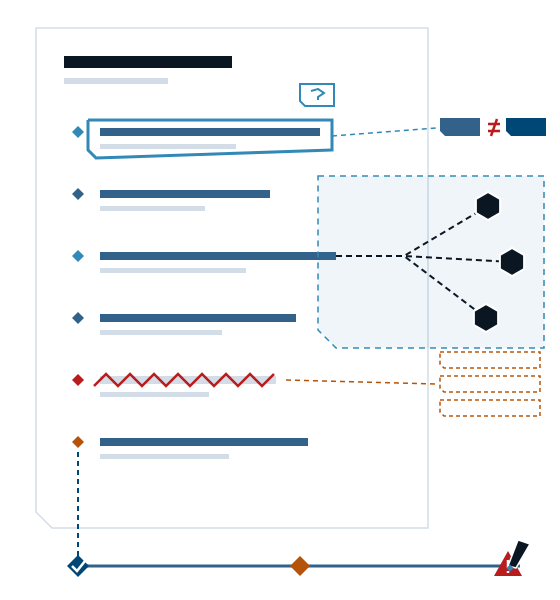
Version compatibility and exact migration requirements are assumed instead of checked against current official guidance.
AI-Assisted IT Change Readiness
Managed pre-change technical review for infrastructure teams
Challenge the plan before the change challenges production.
ITECS Change Assurance is a managed, read-only AI review agent that stress-tests infrastructure change plans before execution. It classifies risk, challenges assumptions, checks current vendor requirements, requires live verification for critical prerequisites, and produces an auditable readiness verdict. It never makes the change.
Review-only. It never executes the change.
Illustrative readiness console
Submitted scope
Fictional shared service
Evidence gate
Critical items remain open
Target-version compatibility
Official requirements
Recovery path is executable
Submitted plan
Live prerequisite observation
Technician verification
Illustrative verdict
NO-GO — critical evidence still required
Change Failure Modes
ITECS Change Assurance is designed to expose hidden risk before work begins. It does not eliminate risk or promise that every outage can be avoided.
Version compatibility and exact migration requirements are assumed instead of checked against current official guidance.
The submitted scope misses upstream, downstream, shared-platform, identity, or access relationships that expand the blast radius.
The plan says “roll back” without defining the trigger, steps, duration, restored state, or point of no return.
Immediate checks look healthy, but delayed jobs, authentication paths, backups, or dependent workflows fail later.
Constructively Adversarial Review
The agent asks focused question batches, distinguishes evidence types, and keeps every unresolved critical item visible through the final decision.
Capture technician identity, ticket or reference, the change description, and the submitted plan with scope, steps, window, backup, rollback, verification, and communications.
Classify the reviewed change as routine, elevated, or critical based on scope, dependencies, reversibility, and required evidence.
Consult approved company and OpsMemory context read-only, then use current official vendor guidance for exact upgrade or migration requirements.
Challenge assumptions in focused question batches and require the technician to inspect the live environment for critical prerequisites.
Record evidence, unresolved risk, rollback criteria, validation checks, sources, and an attributable readiness verdict. The agent never executes the change.
Evidence Model
A current live fact, an official requirement, useful operating context, and an assumption are not interchangeable. Change Assurance keeps those lanes distinct.
Evidence lane 01
Live observation
Technician-reported live observations are required for critical prerequisites. The agent records what the technician inspected and reported.
Evidence lane 02
Official source
Current official vendor guidance establishes supported versions, prerequisites, upgrade paths, and known issues.
Evidence lane 03
Approved documentation
Approved company and OpsMemory documentation supplies history and operating context, but may be stale and does not prove current live state.
Evidence lane 04
Cannot close a critical item
A remembered value or unsupported assumption stays open until stronger evidence or an explicit mitigation is recorded.
Critical evidence must be closed, mitigated, or preserved as explicit accepted risk. Unresolved risk never becomes GO.
Technical Review Surface
The review follows the submitted plan through readiness, reversal, verification, ownership, and delayed-failure questions instead of returning a generic checklist wall.
Risk Treatment
Scope, reversibility, dependencies, and evidence determine treatment. The matrix provides bounded examples, not a certification or universal risk score.
Auditable Decision Record
Each item keeps its evidence state. The readiness verdict summarizes the reviewed plan without hiding open or accepted risk.
Illustrative Review Demonstration
This sanitized scenario uses a fictional shared backup-platform upgrade. It is an example of the review logic—not a customer case study or production incident.
The target is documented, but compatibility is not yet live-verified.
A snapshot is named, but the restoration sequence and trigger are incomplete.
The plan does not include a functional backup-and-restore test.
Critical evidence and mitigations are required before the plan can proceed.
Readiness Report Preview
The report preserves the submitted plan, evidence decisions, sources, readiness verdict, and validation obligations for the exact version reviewed.
Sanitized illustrative report
Fictional shared backup-platform upgrade
Fictional shared backup-platform upgrade · Critical
Live observations remain separate from documentation-only evidence.
Ownership, prerequisites, backup safety, access, and communications.
Explicit trigger, restoration steps, duration, and point of no return.
Immediate functional tests plus T+24h and T+72h silent-failure checks.
Approved internal context and current official vendor requirements.
Operating Relationships
Change Assurance adds disciplined technical challenge without replacing the systems and people that record, authorize, and perform the change.
The ITSM and change workflow records, routes, schedules, and approves a change. ITECS Change Assurance challenges whether the technical plan and evidence are ready. The change owner, approver, CAB, and technician remain responsible.
It works alongside an existing process. This page does not claim a direct integration with a named ticketing platform.
OpsMemory organizes approved knowledge and source context. Change Assurance consults that documentation read-only, flags staleness or conflict, and still requires live proof for critical facts.
Explore OpsMemory source disciplineWho It Is For
The managed service fits teams responsible for consequential technical work where evidence must be clear and people must remain accountable.
Technical directors, service-delivery leaders, and engineering teams managing change risk across multiple client environments.
Teams that need consistent senior-review discipline before high-impact work reaches production.
Organizations that need reviewable evidence while change owners, approvers, and technicians retain authority.
Managed Engagement
ITECS manages the review lifecycle without replacing the customer's ITSM or governance platform.
Map the current intake, review, approval, execution, and post-change ownership path.
Configure risk treatment, approved documentation scope, evidence expectations, report templates, and explicit limits.
Exercise the configured review against fictional or sanitized scenarios before team use.
Teach technicians, reviewers, change owners, and approvers how to use the evidence and verdict record.
Maintain question patterns, rules, documentation boundaries, and report quality as the operating process changes.
FAQ
It is a managed pre-change technical review that challenges an infrastructure plan, classifies its risk, checks current requirements, and records whether the evidence supports proceeding. ITECS Change Assurance produces an auditable verdict for the reviewed plan while people retain approval and execution authority.
No. ITECS Change Assurance is review-only and never executes, deploys, remediates, rolls back, or approves an infrastructure change. The technician and the customer's existing change process remain responsible for action and authorization.
Critical prerequisites require and record technician-reported live verification. Documentation and current official vendor guidance establish context and requirements, but the technician must inspect the live environment and report the observed fact before critical evidence can be marked VERIFIED LIVE.
Scope and evidence determine treatment. Server, multi-user, DNS, GPO, firewall-rule, application, backup and disaster-recovery, identity, hypervisor, core-network, storage, certificate-authority, and shared-platform work commonly needs elevated or critical review, while trivial single-user changes may be routine.
The report includes the submitted plan, scope and risk tier, verified and open evidence, pre-flight checklist, rollback criteria and point of no return, immediate and T+24h and T+72h checks, communications, sources, and the readiness verdict. It is valid only for the reviewed plan and for 14 days, expiring earlier if the plan or target version changes.
Yes, but the override is explicit and attributable. The record preserves the technician's decision and every unresolved risk; an override never converts unresolved risk into GO.
It can use approved company and OpsMemory documentation read-only and can work alongside the customer's existing ticketing and change workflow. Specific repositories, handoffs, and permissions are confirmed during scoping; no direct ticketing connector is promised by this page.
No. The ITSM and change workflow records, routes, schedules, and approves the change, while ITECS Change Assurance challenges whether the technical plan and evidence are ready. The change owner, approver, CAB, and technician remain responsible.
No. It describes the managed service, review policy, and a fictional demonstration. A client rollout begins with sanitized acceptance tests and client-approved evidence criteria; the page does not represent demonstration output as production proof.
Bring a representative change workflow to a focused workshop. ITECS will map the review surface, evidence boundaries, and human approval path without asking the agent to perform the change.